Do you live in India, work abroad, or visit India regularly while earning income overseas? Your residential status can significantly affect how much of your income is taxable in India.
Under Section 6 of the Income-tax Act, 2025, residential status depends on factors such as your physical stay in India, income from Indian sources, previous residential history, and certain special circumstances. Citizenship alone does not determine your residential status for income-tax purposes.
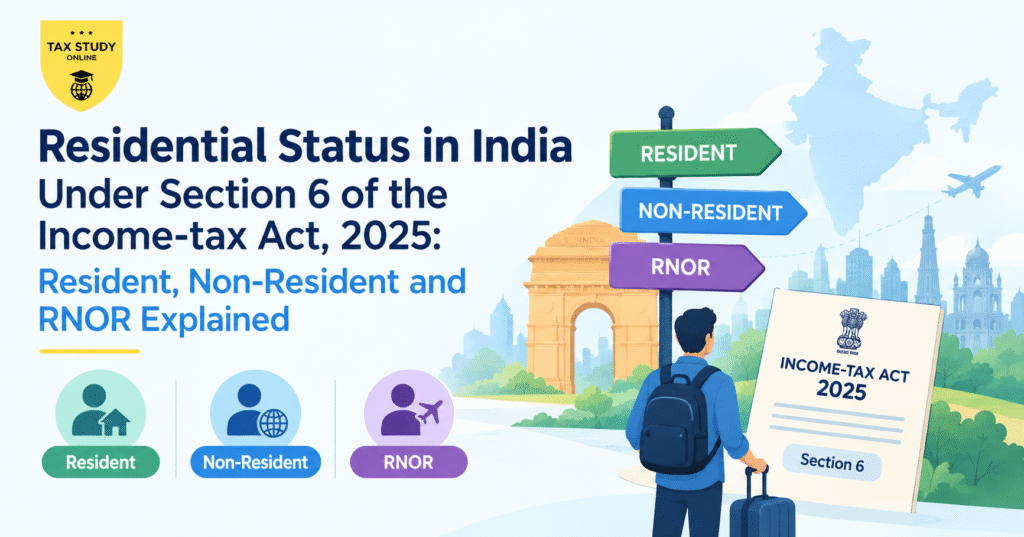
The law recognises three important categories for individuals:
- Resident and Ordinarily Resident (ROR)
- Resident but Not Ordinarily Resident (RNOR)
- Non-Resident (NR)
Understanding these categories can help salaried employees, business owners, returning Indians, Non-Resident Indians (NRIs), and Persons of Indian Origin (PIOs) understand their Indian tax obligations.
Let’s explore Section 6 of the Income-tax Act, 2025, in simple terms.
What Is Residential Status Under Section 6?
Residential status determines whether a person is treated as a resident or non-resident in India for a particular tax year. It also helps determine which income falls within the scope of Indian taxation.
A person’s status must be assessed separately for each tax year. It can change from one year to another depending on the number of days spent in India and the applicable legal conditions.
For example, an Indian citizen working in another country may qualify as a non-resident in one tax year. If the person later spends more time in India and meets the applicable conditions, their status may change.
Important: Residential status for tax purposes is different from citizenship, visa status, or immigration status.
1. The 182-Day Rule
Section 6 provides a general residential test based on the number of days an individual stays in India.
An individual is generally considered a resident if they stay in India for 182 days or more during the relevant tax year.
This is commonly known as the 182-day rule.
Example
Suppose Rahul works remotely and spends 190 days in India during the tax year. If his stay is calculated correctly and no special provision changes the applicable test, he generally qualifies as a resident under the 182-day rule.
However, a person who stays in India for fewer than 182 days may still become a resident under another applicable test.
Therefore, counting only the days spent in India is not always sufficient.
2. The 60-Day Plus 365-Day Rule
An individual may also qualify as a resident if both of the following conditions are satisfied:
- They stay in India for 60 days or more during the relevant tax year.
- They have stayed in India for 365 days or more in total during the four preceding tax years.
Both conditions must be considered together, subject to the exceptions and special rules under Section 6.
Example
Suppose Priya spends 75 days in India during the relevant tax year. She also spent 400 days in India across the preceding four tax years.
She meets both numerical conditions under the general test. However, her final residential status will depend on whether any special rule applies to her circumstances.
This distinction is particularly important for people who travel frequently between India and other countries.
3. Special Rules for Indian Citizens Leaving India for Employment
Section 6 provides a specific relaxation for an Indian citizen who leaves India during a tax year:
- For employment outside India; or
- As a member of the crew of an Indian ship, as specified in the law.
In these circumstances, the 60-day threshold under the general 60-day-plus-365-day test does not apply in the usual way. The relevant test instead uses a 182-day threshold.
Example
Amit is an Indian citizen who leaves India to take up employment overseas. He spends 150 days in India during the relevant tax year.
The ordinary 60-day-plus-365-day test does not automatically make him a resident because the special rule applies to his circumstances. His residential status must be assessed using the applicable 182-day threshold and other relevant provisions.
Note: The special rule concerns the specified circumstances of leaving India. It should not be applied automatically to every Indian citizen living abroad.
4. Special Rules for NRIs and Persons of Indian Origin Visiting India
Section 6 also contains special provisions for Indian citizens and Persons of Indian Origin who live outside India and visit India.
The applicable threshold depends partly on their income, excluding income from foreign sources.
Case A: Indian income does not exceed ₹15 lakh
For an eligible Indian citizen or PIO visiting India, the ordinary 60-day threshold is generally replaced by a 182-day threshold when applying the relevant residency test.
This means the general 60-day-plus-365-day rule does not operate in the same way for this category.
Case B: Indian income exceeds ₹15 lakh
Where the eligible visitor’s total income, excluding income from foreign sources, exceeds ₹15 lakh during the tax year, the threshold may become 120 days, subject to the conditions in Section 6.
The individual may qualify as a resident if they:
- Stay in India for 120 days or more during the tax year; and
- Have stayed in India for 365 days or more in total during the preceding four tax years.
A person who qualifies as a resident under this visiting-Indian rule may be classified as RNOR if the applicable conditions are met.
Example
Neha is a PIO living abroad. Her income, excluding income from foreign sources, exceeds ₹15 lakh during the tax year. She stays in India for 135 days and has spent 380 days in India during the preceding four tax years.
She meets the numerical conditions of the 120-day test. Her residential status must then be determined under Section 6, including the applicable RNOR provisions.
5. The Deemed Resident Rule
Section 6 also contains a deemed-resident provision for certain Indian citizens.
An Indian citizen may be treated as a resident in India even if they do not satisfy the usual day-count tests when both of the following conditions apply:
- Their total income, excluding income from foreign sources, exceeds ₹15 lakh during the tax year.
- They are not liable to tax in any other country or territory because of domicile, residence, or similar criteria.
This rule is intended to address specified situations where an Indian citizen with substantial income connected to India is not liable to tax elsewhere under the criteria described in the law.
Example
Suppose Vikram is an Indian citizen living outside India. His total income, excluding income from foreign sources, exceeds ₹15 lakh. He is also not liable to tax in any other country because of domicile, residence, or a similar criterion.
Even if he spends very few days in India, the deemed-resident provision may apply.
A person treated as a deemed resident under this provision is classified as Resident but Not Ordinarily Resident (RNOR) under Section 6.
6. What Is Resident but Not Ordinarily Resident (RNOR)?
A person who qualifies as a resident does not always qualify as an ordinarily resident. Section 6 provides rules to determine whether an individual is RNOR.
An individual may qualify as RNOR if they meet either of these residential-history conditions:
- They were a non-resident in India in nine out of the ten tax years preceding the relevant tax year; or
- They stayed in India for 729 days or less during the seven tax years preceding the relevant tax year.
Specific provisions also cover certain visiting Indian citizens and PIOs whose income, excluding foreign-source income, exceeds ₹15 lakh and who meet the applicable 120-day threshold. Deemed residents are also treated as RNOR.
Example
Arjun returns to India after working overseas for several years. He qualifies as a resident for the current tax year but was a non-resident in nine of the ten preceding tax years.
He may qualify as RNOR under the residential-history test.
The final classification depends on the applicable conditions and the facts of his case.
7. Difference Between ROR, RNOR and Non-Resident
| Residential status | General meaning | Broad scope of Indian taxation |
| Resident and Ordinarily Resident (ROR) | A resident who does not qualify as RNOR | Generally includes Indian income and foreign income, subject to applicable law |
| Resident but Not Ordinarily Resident (RNOR) | A resident who meets the RNOR conditions | Generally includes Indian income and certain foreign income connected with a business controlled in India or a profession set up in India |
| Non-Resident (NR) | An individual who does not meet the applicable residency conditions | Generally includes income received or deemed received in India and income accruing, arising, or deemed to accrue or arise in India |
The scope of taxable income depends on the relevant statutory provisions and the facts of each case. Tax treaties, exemptions, and other provisions may also be relevant.
8. How Is Residential Status Determined for Companies and Other Entities?
Section 6 also addresses the residential status of persons other than individuals.
Indian companies
An Indian company is generally treated as a resident in India under the applicable provisions.
Foreign companies
A foreign company may be treated as a resident if its Place of Effective Management (POEM) is in India, subject to the relevant legal provisions and applicable rules.
POEM broadly concerns the place where the key management and commercial decisions necessary for the conduct of an entity’s business as a whole are made.
Hindu Undivided Families (HUFs), firms and other entities
For other persons, the general rule under Section 6 considers whether the control and management of their affairs are situated wholly outside India.
A person other than an individual is generally treated as a resident unless the control and management of its affairs are situated wholly outside India during the relevant tax year, subject to the applicable provisions.
The residential status of an HUF also requires consideration of the special rules governing whether it is ordinarily resident or not ordinarily resident.
9. Why Does Residential Status Matter for Income Tax?
Residential status affects which income may be taxable in India. It can therefore be important for people who earn money in India and overseas.
For Resident and Ordinarily Resident individuals
ROR individuals are generally taxable in India on their Indian income and foreign income, subject to applicable exemptions, reliefs, tax treaties and other provisions.
For Resident but Not Ordinarily Resident individuals
RNOR individuals are generally taxable on income received or deemed to be received in India and income that accrues or arises, or is deemed to accrue or arise, in India. Certain foreign income may also be taxable if it is derived from a business controlled in India or a profession set up in India.
For Non-Resident individuals
Non-residents are generally taxable on income received or deemed to be received in India, and income that accrues or arises, or is deemed to accrue or arise, in India, subject to applicable provisions and reliefs.
For example, an NRI earning rental income from a property in India may have Indian tax obligations even if they qualify as a non-resident.
Similarly, foreign income earned by an ROR individual may need to be considered while calculating taxable income in India.
10. Practical Checklist to Determine Your Residential Status
Before deciding whether you are a resident, non-resident or RNOR, review the following points:
- Count your days of physical stay in India during the relevant tax year.
- Calculate your total days in India during the preceding four tax years.
- Review your stay in India during the preceding seven and ten tax years, where relevant.
- Determine whether you are an Indian citizen or a PIO visiting India.
- Check whether you left India for employment abroad or as a qualifying ship crew member.
- Calculate your total income excluding income from foreign sources to determine whether the ₹15 lakh threshold applies.
- Check whether the deemed-resident provision is relevant to your circumstances.
- Review the scope of income taxable in India after determining your residential status.
Keep travel records, passport details, entry and exit dates, income statements and relevant overseas tax documents. These records can help support your residential-status calculation.
Conclusion
Section 6 of the Income-tax Act, 2025, provides the rules for determining whether an individual is a Resident, Non-Resident or Resident but Not Ordinarily Resident in India. The decision depends on day-count tests, previous residential history, income thresholds and specific provisions for Indian citizens and PIOs.
The 182-day rule and the 60-day-plus-365-day rule are important starting points, but special rules may change the result. Residential status also affects whether foreign income falls within the scope of Indian taxation.
If you live abroad, frequently visit India, or plan to return to India, review your residential status for each tax year carefully. Consider consulting a qualified tax professional when the rules involve multiple countries, foreign income or complex travel history.
FAQs
1. What is Section 6 of the Income-tax Act, 2025?
Section 6 determines a person’s residential status in India for a tax year. It covers the conditions for being a resident, the deemed-resident rule, and the classification of certain residents as RNOR.
2. Is staying in India for 182 days enough to become a resident?
Generally, staying in India for 182 days or more during the tax year satisfies one of the main residency tests for an individual. However, the complete facts and applicable provisions should be reviewed.
3. What is the 60-day-plus-365-day rule?
Under the general rule, an individual may become a resident by staying in India for at least 60 days during the relevant tax year and at least 365 days during the four preceding tax years. Special provisions apply to certain categories of individuals.
4. When does the 120-day rule apply to NRIs and PIOs?
The 120-day threshold may apply to an eligible Indian citizen or PIO visiting India whose total income, excluding income from foreign sources, exceeds ₹15 lakh, provided the other statutory conditions are met.
5. Who is considered a deemed resident in India?
An Indian citizen may be treated as a deemed resident if their total income, excluding income from foreign sources, exceeds ₹15 lakh and they are not liable to tax in any other country or territory because of domicile, residence or similar criteria.
6. What is the difference between ROR and RNOR?
Both categories refer to residents of India. ROR individuals are generally taxable on worldwide income, subject to applicable law. RNOR individuals are generally taxable on Indian income and certain foreign income connected with a business controlled in India or a profession set up in India.
7. Does citizenship alone determine residential status?
No. Residential status generally depends on the applicable day-count tests, residential history, income and special provisions. Citizenship is relevant in certain specific rules but does not determine the outcome by itself.
8. Is foreign income taxable for an NRI?
Foreign income that neither is received or deemed received in India nor accrues or arises, or is deemed to accrue or arise, in India is generally outside the Indian tax scope for a non-resident. The exact result depends on the facts and applicable law.