GST

Commercial Credit Note vs GST Credit Note Key Differences, GST Implications, Accounting Treatment & Practical Examples

Commercial Credit Note vs GST Credit Note: Key Differences and GST Implications

In business, suppliers may sometimes need to reduce the value of transactions due to sales returns, post-sale discounts, pricing revisions, incentive schemes, damaged goods, or billing errors. To record such reductions, businesses issue credit notes. However many taxpayers find it difficult to understand the difference between a Commercial Credit Note and a GST Credit Note. […]

Commercial Credit Note vs GST Credit Note: Key Differences and GST Implications Read More »
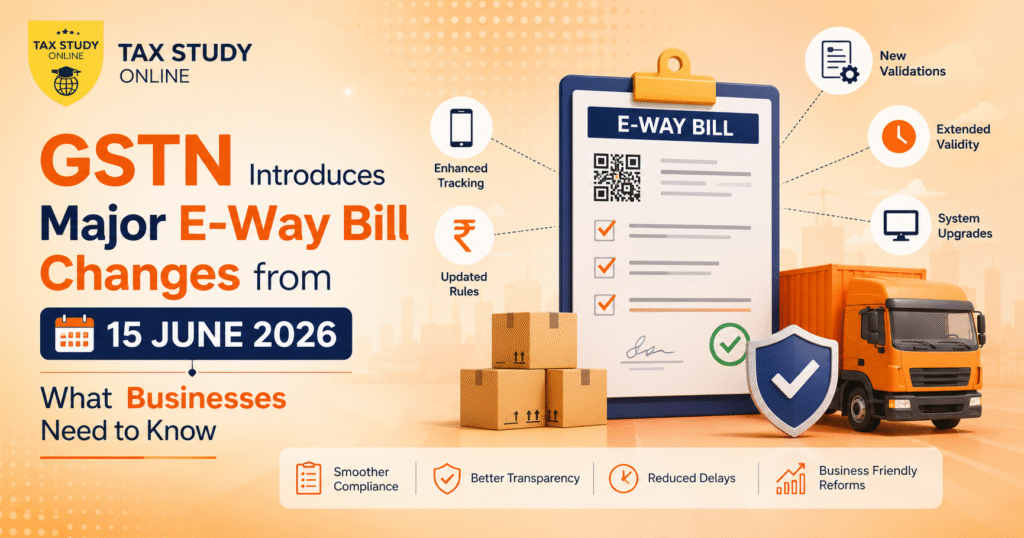
GSTN Introduces Major E-Way Bill Changes from 15 June 2026 What Businesses Need to Know

GSTN Introduces Major E-Way Bill Changes from 15 June 2026: What Businesses Need to Know

The Goods and Services Tax Network (GSTN) has announced significant updates to the E-Way Bill system that will impact businesses involved in the movement of goods across India. As per the GSTN advisory issued on 20 May 2026, two important enhancements are scheduled to be implemented on the E-Way Bill portal by 15 June 2026.

GSTN Introduces Major E-Way Bill Changes from 15 June 2026: What Businesses Need to Know Read More »

Accounts and Records Under GST Analysis of Section 35

Accounts and Records Under GST: Analysis of Section 35

The Goods and Services Tax (GST) system in India is built on transparency, accountability, and proper documentation. One of the most important compliance requirements under GST is the maintenance of proper books of accounts and records. To ensure systematic compliance, Section 35 of the Central Goods and Services Tax (CGST) Act, 2017 lays down detailed

Accounts and Records Under GST: Analysis of Section 35 Read More »

IGST, CGST, SGST – How New Rules Give Businesses Control Over ITC

IGST, CGST, SGST – How New Rules Give Businesses Control Over ITC

The Indian GST system continues to evolve to make compliance more business-friendly and to improve cash flow management. One of the most significant updates is the change in Input Tax Credit (ITC) utilisation rules for IGST liabilities, effective January 2026. This update may seem technical, but its implications are far-reaching, giving businesses more flexibility, strategic

IGST, CGST, SGST – How New Rules Give Businesses Control Over ITC Read More »

Service Accounting Codes (SAC) and Its Relevance Under GST A Detailed Analysis

Service Accounting Codes (SAC) and Its Relevance Under GST? – A Detailed Analysis

The United Nations Statistical Division (i.e.; UNSD) developed the UN Central Product Classification (i.e.; UN-CPC), and based on this, the Central Board of Indirect Taxes and Customs (i.e., CBIC) developed the SAC codes with some modification in the Indian context. What is Service Accounting Code (SAC)? The term SAC stands for Service Accounting Code. We

Service Accounting Codes (SAC) and Its Relevance Under GST? – A Detailed Analysis Read More »

GST Alert Major Changes in Credit Notes from 1 October 2025 — Provisions Explained!

GST Alert: Major Changes in Credit Notes from 1 October 2025 — Provisions Explained!

From 1 October 2025, the GST rules in India will change, especially for credit notes and their reflection in the GSTR-2B. What’s Changing? Under the revised process, credit notes issued by suppliers will now require explicit acceptance by customers (recipients) in the Invoice Matching System (IMS). If a buyer rejects a credit note, the supplier’s

GST Alert: Major Changes in Credit Notes from 1 October 2025 — Provisions Explained! Read More »

How “GST 2.0” Could Boost Festive Season Spending

How “GST 2.0” Could Boost Festive Season Spending

India’s festive season has always been more than just a time for celebration—it’s also the heartbeat of the country’s economy. From sweets and clothing to cars and gold, spending surges across industries during Navratri, Diwali, and Christmas. With the introduction of GST 2.0 in 2025, the government has made sweeping changes to the tax structure

How “GST 2.0” Could Boost Festive Season Spending Read More »

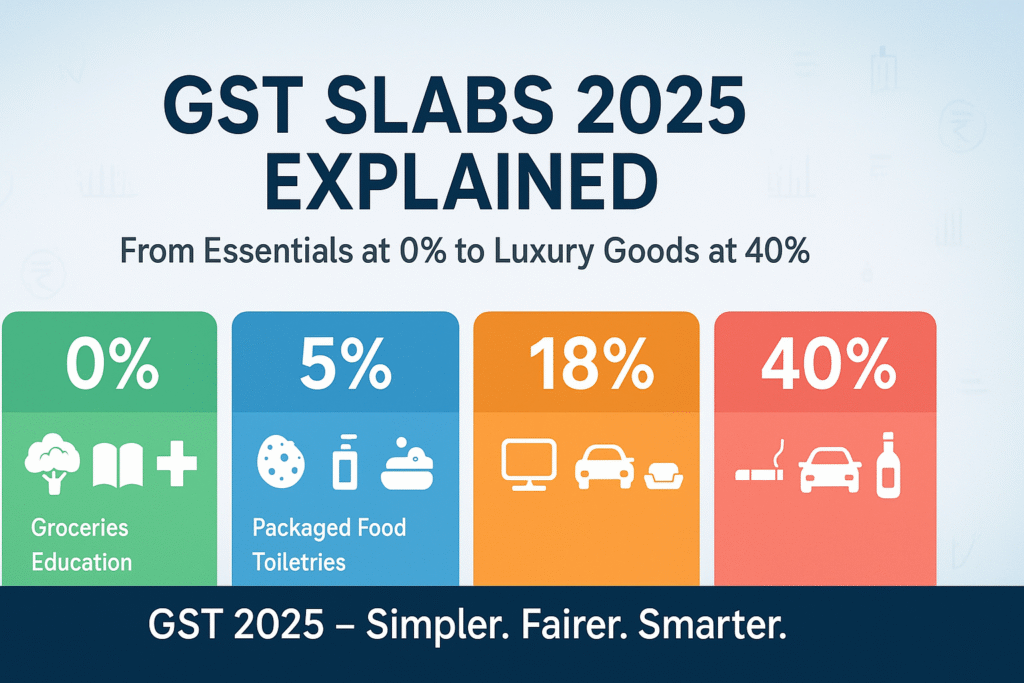
GST Slabs 2025 Explained From Essentials at 0% to Luxury Goods at 40%

GST Slabs 2025 Explained: From Essentials at 0% to Luxury Goods at 40%

The Goods and Services Tax (GST) has undergone its biggest reform since implementation. Effective 22 September 2025, the Government of India simplified the structure by reducing multiple rates and introducing a new luxury slab. This move is aimed at making taxation more transparent, easing compliance, and providing relief to common consumers. If you’re a business

GST Slabs 2025 Explained: From Essentials at 0% to Luxury Goods at 40% Read More »