Income tax plays an important role in India’s economic development. It provides revenue for public infrastructure, healthcare, education, transportation and other essential government services. At the same time, income tax affects how much money individuals can spend, save and invest.
In the Union Budget 2025–26, the Government of India announced significant personal income tax relief under the new tax regime. The revised tax structure introduced a rebate that allows eligible resident individuals to pay no income tax on normal income up to ₹12 lakh, subject to the applicable conditions. For salaried taxpayers, the threshold can reach ₹12.75 lakh because of the ₹75,000 standard deduction.
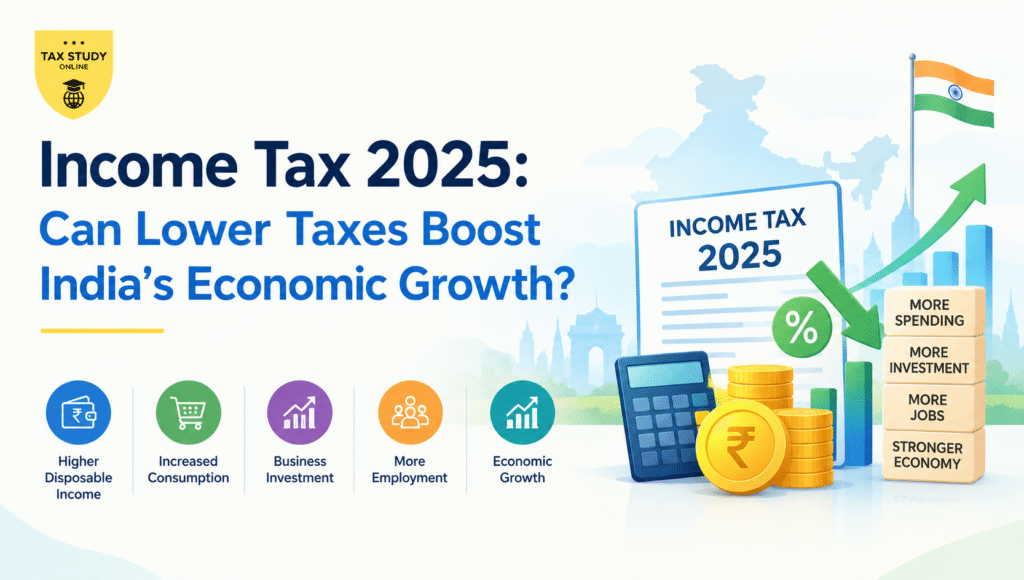
These changes raise an important economic question: Can lower income taxes boost India’s economic growth?
Lower taxes can leave households with more disposable income, encourage consumption, support business activity and influence investment decisions. However, their overall impact depends on consumer behaviour, business confidence, government spending and the country’s economic conditions.
1. Understanding Income Tax Reforms in 2025
The Union Budget 2025–26 introduced significant changes to the new income tax regime to provide relief to individual taxpayers, particularly the middle class.
The revised tax structure applies to the relevant income earned during FY 2025–26, corresponding to AY 2026–27.
Key highlights of the 2025 income tax reforms
- Higher tax-free income threshold: Eligible resident individuals with normal income up to ₹12 lakh can receive a rebate that eliminates their income tax liability under the new regime.
- Relief for salaried employees: The ₹75,000 standard deduction can raise the effective nil-tax threshold to ₹12.75 lakh for eligible salaried taxpayers.
- Revised tax slabs: The new regime introduced revised income brackets and lower rates at several income levels.
- Higher disposable income: Eligible taxpayers can retain more of their earnings after paying income tax.
- Focus on consumption and investment: The Government expects tax relief to support household consumption, savings and investment.
These measures aim to reduce the tax burden on individuals while supporting economic activity. The actual benefit depends on taxable income, the applicable tax regime, rebate eligibility and the nature of the income. Special-rate income, such as certain capital gains, does not qualify for the rebate in the same way as normal income.
2. How Can Lower Income Taxes Boost Economic Growth?
Economic growth depends on several factors, including consumer demand, private investment, productivity, employment and government expenditure.
When individuals pay less income tax, they retain a larger share of their earnings. They can use this additional money to purchase goods, pay for services, repay debt, save or invest.
This can influence the economy through several channels.
A. Higher consumer demand
When households have more disposable income, they may increase spending on everyday needs, electronics, clothing, education, travel and other services.
Higher demand can encourage businesses to increase production, expand operations and purchase additional supplies.
B. Greater business activity
When consumer demand rises, businesses may experience higher sales. This can improve cash flow and encourage business owners to invest in equipment, technology, marketing and additional capacity.
C. Potential employment growth
Businesses that experience sustained demand may need more employees to manage production, sales, logistics and customer service.
D. Greater investment
Taxpayers may use part of their additional income for deposits, mutual funds, shares, retirement savings or other financial assets.
The overall effect depends on how households allocate the money and how effectively businesses respond to increased demand.
3. Impact on Household Spending and Consumption
Consumer spending is an important component of India’s economy. When people have more money available after taxes, they gain greater flexibility in managing their household budgets.
For example, a salaried employee who receives tax relief may use the additional money to pay rent, purchase household appliances, finance education or spend on healthcare.
Consider a hypothetical taxpayer who saves ₹40,000 in income tax over a year.
The taxpayer might allocate the amount as follows:
| Use of additional money | Illustrative amount |
| Household purchases | ₹15,000 |
| Education and healthcare | ₹8,000 |
| Savings and investments | ₹12,000 |
| Debt repayment | ₹5,000 |
| Total | ₹40,000 |
These figures illustrate one possible allocation, not an estimate of actual taxpayer behaviour.
If many households increase their purchases, retailers, manufacturers, restaurants, transport providers and service businesses may benefit from stronger demand.
However, not every taxpayer will spend the entire tax saving. Some may prefer to save the money, repay loans or build an emergency fund. Therefore, tax relief can support consumption, but the size of the effect depends on household priorities.
4. How Tax Relief Can Support Businesses
Lower personal income taxes can also influence businesses indirectly.
When households spend more, businesses may receive more orders and generate additional revenue. This can improve their ability to maintain operations, expand production and invest in new services.
Small and medium enterprises (SMEs) may benefit when customers increase spending on local products, professional services, retail goods and hospitality.
Key business benefits
- Higher sales: Additional household spending can increase demand for products and services.
- Improved cash flow: Stronger sales can help businesses manage operating expenses and working capital.
- Business expansion: Companies may invest in new equipment, digital systems, additional outlets and production facilities when demand justifies the expenditure.
- Greater market confidence: Consistent consumer demand can encourage entrepreneurs to develop new products and enter new markets.
Nevertheless, personal income tax cuts do not directly reduce the corporate income tax liability of a company. Any business benefit may arise indirectly through customer demand, employee incentives and wider economic activity.
Businesses also need access to credit, skilled workers, infrastructure and stable policies to convert higher demand into sustainable growth.
5. The Connection Between Tax Cuts and Employment
Employment growth depends on whether businesses have sufficient demand and the resources to expand their operations.
Lower personal income taxes may contribute to employment growth when they encourage households to spend more and businesses respond by increasing production.
For example, stronger consumer demand could encourage a retailer to hire more sales staff or a manufacturer to add workers to a production line.
The potential employment benefits may extend to several sectors:
- Retail and e-commerce
- Manufacturing
- Hospitality and tourism
- Transportation and logistics
- Education and healthcare
- Financial and professional services
- Information technology
However, tax relief does not guarantee new jobs. Businesses may respond to higher demand by increasing productivity, using existing capacity or investing in automation instead of hiring additional employees.
Employment gains therefore depend on the strength and duration of demand, business investment and broader labour market conditions.
6. Can Lower Taxes Encourage Savings and Investment?
Lower income taxes can influence both household savings and investment decisions.
When taxpayers retain more of their income, they can build emergency funds, repay outstanding loans or invest in financial assets.
These choices can support financial stability and may contribute to the availability of funds for investment in the wider economy.
How additional income may support investment
- Financial investments: Individuals may invest in shares, mutual funds, bonds or other eligible financial products.
- Business investment: Entrepreneurs and self-employed professionals may use additional savings to purchase equipment, improve technology or expand their operations.
- Housing and property: Some households may save for a home purchase or related expenses.
- Education and skill development: Individuals may invest in professional courses and training that improve their long-term earning potential.
The economic impact depends on how savings flow through financial institutions and capital markets into productive investment. Higher savings alone do not automatically produce higher economic growth.
Taxpayers should also compare the benefits of different tax regimes and consider their financial goals before making investment decisions.
7. Impact on Government Revenue
Although lower taxes can support consumption and investment, they also reduce the amount of income tax that the government collects in the short term.
The Government must balance tax relief with its responsibility to fund infrastructure, education, healthcare, public services and other development programmes.
The Union Budget 2025–26 estimated that the direct tax proposals would result in revenue forgone of approximately ₹1 lakh crore.
This illustrates an important policy trade-off: taxpayers retain more income, but the government initially collects less revenue from the affected tax measures.
Can economic growth recover the lost tax revenue?
Stronger economic activity may increase government revenue over time through higher consumption, business profits, employment and taxable incomes.
However, the outcome is not automatic. The additional economic activity may not generate enough revenue to offset the original tax reduction.
The final result depends on factors such as:
- The size and design of the tax relief.
- How much additional income households spend or save.
- The response of businesses to higher demand.
- Changes in employment and investment.
- Overall economic growth and tax compliance.
- The government’s expenditure and borrowing decisions.
Policymakers must assess both the immediate revenue cost and the longer-term economic benefits.
8. Challenges and Limitations of Lower Taxes
Income tax reductions can support economic activity, but they are not a complete solution to every economic challenge.
A. Households may save rather than spend
Some taxpayers may use additional income to repay loans or build savings instead of purchasing goods and services. This can reduce the immediate boost to consumer demand.
B. Benefits differ across income groups
Taxpayers who pay little or no income tax may receive limited direct benefit from a reduction in income tax rates. They may still benefit indirectly if the policy supports employment and economic activity.
C. Inflation can reduce purchasing power
If prices rise significantly, households may not experience a corresponding increase in their real purchasing power.
D. Government spending may face pressure
Lower tax collections can restrict the government’s financial flexibility if other revenue sources do not compensate for the reduction.
E. Structural reforms remain important
Tax relief alone cannot resolve challenges involving infrastructure, skill shortages, access to finance, productivity or business regulation.
For sustainable growth, tax policy should work alongside measures that improve education, infrastructure, employment opportunities and the business environment.
9. Who Benefits from Income Tax Reductions?
The impact of lower income taxes varies by taxpayer category.
| Taxpayer category | Potential benefit |
| Salaried employees | Higher take-home income for eligible taxpayers |
| Middle-income households | More flexibility for spending, savings and debt repayment |
| Self-employed professionals | Potential tax savings and additional funds for personal or business needs |
| Small business owners | Indirect benefits from stronger consumer demand |
| Retailers and service providers | Potential increase in customer spending |
| Investors | Additional funds available for investment |
| Job seekers | Potential indirect benefits if businesses expand and hire |
Tax benefits depend on the applicable tax regime, taxable income, rebate eligibility and other legal conditions. A taxpayer should calculate the liability under both available regimes where applicable rather than assuming that the new regime always produces the lowest tax.
10. Income Tax 2025 and the New Income-tax Act
The phrase Income Tax 2025 can refer to the tax relief announced in the 2025 Budget or to the Income-tax Act, 2025.
These are related but distinct developments.
The Income-tax Act, 2025 received presidential assent on 21 August 2025 and came into force on 1 April 2026. The Act replaced the Income-tax Act, 1961 and introduced a reorganised legal framework designed to make tax provisions easier to understand. The government stated that the new Act focuses on simplifying the law without changing the underlying tax policy merely through that restructuring.
The 2025 Budget tax relief and the new Act should therefore not be confused with each other. The Budget changed the relevant tax slabs and rebate provisions, while the new Act reorganised the legislative framework.
For taxpayers, understanding the applicable financial year, tax regime and legal provisions is essential when calculating income tax or filing an income tax return.
Conclusion
Lower income taxes can contribute to India’s economic growth by increasing disposable income, supporting household consumption and encouraging investment. When businesses experience stronger demand, they may expand operations and create additional employment opportunities.
The income tax relief announced in Budget 2025–26 reflects an effort to provide financial support to eligible taxpayers while encouraging consumption, savings and investment.
However, the long-term impact depends on more than tax rates. Household spending patterns, business confidence, productivity, employment opportunities and government revenue all influence the final outcome.
Frequently Asked Questions
1. Can lower income taxes boost India’s economic growth?
Yes. Lower income taxes can increase disposable income, support consumer spending and encourage investment. The actual effect depends on household behaviour, business activity and the wider economic environment.
2. What income tax relief did Budget 2025–26 announce?
The Budget introduced a rebate structure under which eligible resident individuals with normal income up to ₹12 lakh can have zero income tax liability under the new regime, subject to applicable conditions. The ₹75,000 standard deduction raises the effective threshold to ₹12.75 lakh for eligible salaried taxpayers.
3. How do lower taxes affect consumer spending?
Lower taxes can leave households with more money after tax. They may spend some of this money on goods and services, potentially increasing demand for businesses across different sectors.
4. Do lower income taxes automatically create more jobs?
No. Lower taxes may encourage consumer spending and business expansion, which can support employment. However, hiring also depends on demand, business confidence, investment and productivity.
5. Can lower income taxes reduce government revenue?
Yes. Tax reductions can lower government revenue initially. Stronger economic activity may generate additional revenue over time, but it does not guarantee that the government will recover the entire amount of revenue forgone.
6. How can salaried employees benefit from the 2025 tax changes?
Eligible salaried employees may benefit from revised tax slabs, the enhanced rebate under the new regime and the standard deduction. The actual tax liability depends on taxable income, applicable conditions and the tax regime selected.
7. Is the Income-tax Act, 2025 the same as the 2025 Budget tax relief?
No. The Budget introduced tax changes, including revised slabs and rebate provisions. The Income-tax Act, 2025 reorganised the income tax legislation and came into force on 1 April 2026.