
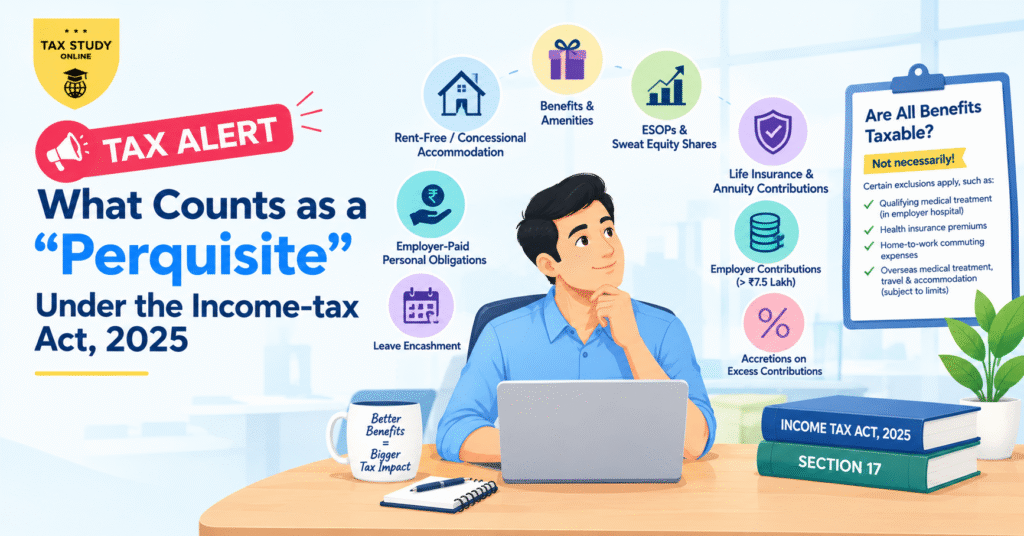
Is Your Salary More Than Your Monthly Pay Cheque?
Your salary package may include much more than your basic pay, allowances, and monthly take-home salary. Employers may also provide accommodation, company shares, insurance benefits, and other facilities.
But are these benefits always tax-free?
No. Some employer-provided benefits may qualify as taxable perquisites under the Income-tax Act, 2025.
Section 17 of the Income-tax Act, 2025 defines perquisites and identifies various benefits that may have tax implications. The applicable tax treatment depends on the type of benefit, its valuation, and the relevant conditions or exclusions.
Understanding these rules can help employees review their salary packages, understand their tax liability, and avoid surprises when filing their Income Tax Returns (ITRs).
What Is a Perquisite Under the Income-tax Act, 2025?
A perquisite is generally a benefit, facility, or payment provided by an employer to an employee in addition to regular salary.
Perquisites may be provided in cash or in kind. Examples include rent-free accommodation, specified employee stock options, and certain employer-paid personal expenses.
Under Section 17 of the Income-tax Act, 2025, several types of employer-provided benefits fall within the definition of perquisites. However, not every benefit is automatically taxable. Specific exclusions and valuation rules may apply.
1. Rent-Free or Concessional Accommodation
When an employer provides accommodation to an employee, the benefit may qualify as a perquisite.
This includes:
- Rent-free accommodation: A house or other qualifying accommodation provided without charging rent.
- Concessional accommodation: Accommodation provided at a rent lower than its prescribed value.
The taxable value is calculated according to the applicable valuation rules. The amount, therefore, may differ from the actual rent paid by the employer.
Example: An employer provides an employee with accommodation at a subsidised rent. The difference between the prescribed value and the rent recoverable from the employee may be relevant when calculating the taxable perquisite.
2. Employer-Provided Benefits and Amenities
Employers may offer benefits and facilities at no cost or at a reduced price. Certain benefits qualify as perquisites under Section 17, depending on the employee’s position and the applicable rules.
These may include specified facilities provided to company directors, employees with substantial interests in the company, and other employees who meet the prescribed salary conditions.
Examples may include certain personal facilities or amenities provided by the employer.
The tax treatment depends on the nature of the benefit, the employee’s circumstances, and the applicable valuation provisions.
3. ESOPs and Sweat Equity Shares
Employee Stock Option Plans (ESOPs) can form an important part of an employee’s compensation package.
Under Section 17, specified securities or sweat equity shares allotted or transferred by a current or former employer, free of cost or at a concessional rate, may qualify as a perquisite.
The value of the benefit is generally determined using the prescribed valuation approach, taking into account the fair market value and the amount paid by the employee.
Example: An employee receives eligible shares worth ₹1,00,000 under the applicable valuation rules and pays ₹40,000 for them. The potential perquisite value would be ₹60,000, subject to the statutory valuation provisions.
Employees should review the applicable rules carefully because ESOP taxation may involve specific timing and valuation requirements.
4. Employer-Paid Personal Obligations
Sometimes, an employer pays an expense that the employee would otherwise have been required to pay personally.
Section 17 includes certain payments made by an employer towards an obligation that would otherwise have been payable by the employee.
For example, if an employer pays a personal liability on behalf of an employee, the payment may qualify as a taxable perquisite, subject to the relevant provisions.
Employees should distinguish between business expenses incurred for official duties and personal obligations paid by the employer.
5. Certain Life Insurance and Annuity Contributions
Certain amounts paid by an employer to obtain life assurance or an annuity contract for an employee may also qualify as perquisites.
Section 17 provides specific exclusions for certain funds, including recognised provident funds and approved superannuation funds, subject to the relevant provisions.
Therefore, the tax treatment depends on the nature of the arrangement and whether it falls within a statutory exclusion.
6. Employer Contributions Exceeding ₹7.5 Lakh
Employer contributions to certain retirement-related funds and schemes may also have tax implications.
Under Section 17, the aggregate employer contributions exceeding ₹7,50,000 in a tax year to the following specified arrangements may qualify as a perquisite:
- Recognised provident fund
- Pension scheme referred to in Section 124(1)
- Approved superannuation fund
The threshold applies to the aggregate contributions covered by the provision, rather than separately to each listed arrangement.
Example
Suppose an employer makes the following contributions for an employee during a tax year:
| Contribution | Amount |
| Recognised provident fund | ₹4,00,000 |
| Eligible pension scheme | ₹2,50,000 |
| Approved superannuation fund | ₹2,00,000 |
| Total contributions | ₹8,50,000 |
| Threshold under Section 17 | ₹7,50,000 |
| Excess contribution | ₹1,00,000 |
In this example, the contributions exceed the threshold by ₹1,00,000. The excess may qualify as a perquisite under Section 17, subject to the applicable provisions.
Employees should check their employer’s contribution statements to understand how the aggregate amount is calculated.
7. Interest and Other Accretions on Excess Contributions
Tax implications may continue even after the original employer contributions are made.
Section 17 also covers the annual accretion by way of interest, dividends, or other similar amounts credited to the relevant funds or schemes, to the extent attributable to contributions covered by the excess-contribution provision.
The amount is calculated according to the prescribed method.
This means employees may need to consider both the excess contributions and the related annual accretions when reviewing the tax treatment of their retirement benefits.
Are All Employer-Provided Benefits Taxable?
No. Section 17 also provides exclusions for specified benefits, subject to applicable conditions.
Some examples include:
1. Qualifying Medical Treatment
Medical treatment provided to an employee or an eligible family member in a hospital maintained by the employer may fall within the statutory exclusion.
Certain qualifying medical expenses at government-maintained or other eligible approved hospitals may also be excluded.
2. Eligible Health Insurance Premiums
Certain employer-paid premiums for employee health insurance under qualifying schemes are covered by the exclusions in Section 17.
The exact treatment depends on the applicable statutory conditions.
3. Home-to-Workplace Commuting
Specified expenditure incurred by the employer for a vehicle used for travel between the employee’s residence and workplace, or the return journey, is covered by an exclusion under Section 17.
4. Overseas Medical Treatment and Travel
Certain expenses incurred for medical treatment outside India, related overseas accommodation, and travel for the employee or eligible family members may qualify for exclusion.
However, the exclusion is subject to prescribed conditions. Medical treatment and stay expenses are subject to applicable limits permitted by the Reserve Bank of India, while travel expenses are subject to the prescribed gross-total-income threshold.
Important: Do not assume that every medical reimbursement, insurance payment, or travel benefit is automatically tax-free. Check the exact conditions under Section 17 and the applicable rules.
How Do Perquisites Affect Your CTC and Take-Home Salary?
Perquisites can affect how employees understand their overall compensation.
Consider these possible components of an employment package:
| Salary component | Possible tax consideration |
| Basic salary | Taxable salary income under applicable provisions |
| Rent-free accommodation | Perquisite valuation rules may apply |
| Eligible ESOPs | Perquisite valuation and timing rules may apply |
| Employer-paid personal expenses | May qualify as a perquisite |
| Employer contributions above the specified threshold | Excess may qualify as a perquisite |
| Qualifying employer-provided medical treatment | May fall within a statutory exclusion |
A benefit included in your Cost to Company (CTC) does not necessarily mean the entire amount will be taxable in the same way as cash salary. The treatment depends on the relevant provision and valuation method.
Employees should review their salary structure, payslips, employer-provided benefit statements, and tax computation before filing an ITR.
Practical Checklist for Employees
Use this checklist when reviewing your annual salary and benefits:
- Check whether your employer provides rent-free or subsidised accommodation.
- Review any ESOPs or sweat equity shares received.
- Identify personal expenses paid by your employer.
- Verify employer contributions to the specified retirement funds and schemes.
- Check whether aggregate eligible contributions exceed ₹7,50,000.
- Review interest or other accretions linked to excess contributions.
- Keep supporting documents for eligible medical and insurance benefits.
- Confirm the applicable valuation rules and exclusions before calculating taxable salary.
Keeping accurate records can help you understand your salary taxation and reduce the risk of reporting errors.
Conclusion
Perquisites are an important part of salary taxation because employee compensation often includes more than cash payments.
Under Section 17 of the Income-tax Act, 2025, accommodation, specified employee benefits, ESOPs, employer-paid personal obligations, certain insurance or annuity payments, and excess employer contributions to specified funds may have tax implications.
At the same time, the law provides exclusions for certain qualifying medical, insurance, and commuting benefits.
The key takeaway: Review your entire salary package, understand how each benefit is valued, and verify the applicable rules before calculating your taxable salary.
Frequently Asked Questions
1. What is a perquisite under the Income-tax Act, 2025?
A perquisite is generally a benefit, facility, or payment provided by an employer in addition to regular salary. Section 17 identifies benefits that may qualify as perquisites and specifies certain exclusions.
2. Which section of the Income-tax Act, 2025 deals with perquisites?
Section 17 of the Income-tax Act, 2025 deals with perquisites. It covers accommodation, specified employee benefits, ESOPs, certain employer-paid obligations, and contributions to specified retirement funds and schemes.
3. Are rent-free accommodation and company-provided housing taxable?
They may be taxable perquisites. The value of rent-free or concessional accommodation is calculated according to the applicable valuation rules and the employee’s circumstances.
4. Are employer contributions above ₹7.5 lakh taxable?
The aggregate employer contributions exceeding ₹7,50,000 in a tax year to the specified recognised provident fund, pension scheme under Section 124(1), and approved superannuation fund may qualify as a perquisite. Related accretions may also have tax implications under the prescribed method.
5. Are employer-provided medical benefits always taxable?
No. Section 17 excludes certain qualifying medical treatment, health insurance premiums, and overseas medical expenses, subject to specified conditions. Other reimbursements may receive different tax treatment.
