Do you think your salary means only the monthly amount credited to your bank account? Think again!
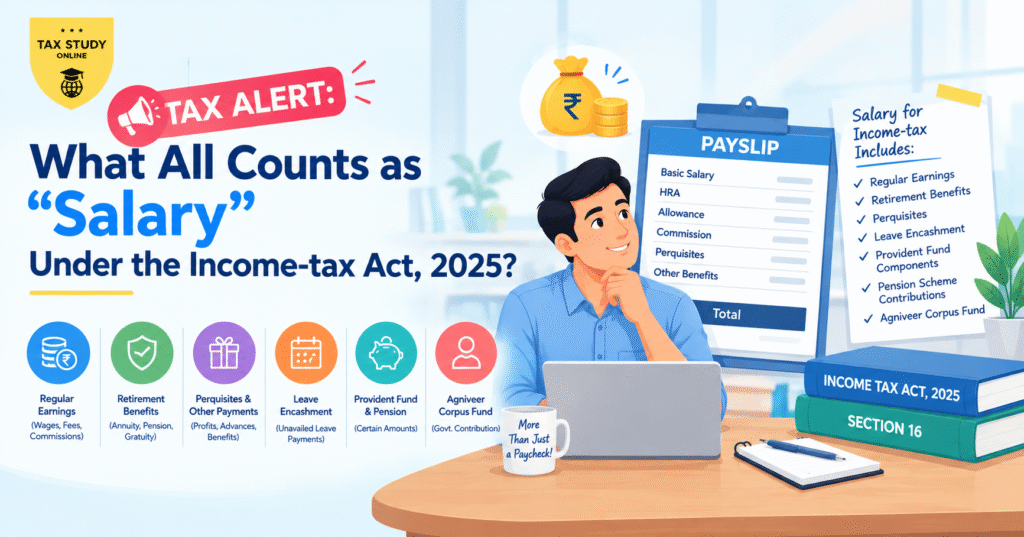
For income-tax purposes, salary can include much more than basic pay and monthly wages. Commissions, pension, gratuity, leave encashment, perquisites, certain employer contributions, and other payments may also fall within the definition of salary.
Understanding these components is important because your salary for income-tax purposes may differ from your take-home pay.
The Income-tax Act, 2025 explains what qualifies as salary under Section 16, while Section 15 specifies when salary income becomes chargeable to tax.
1. What Does Salary Mean Under the Income-tax Act, 2025?
Under Section 16 of the Income-tax Act, 2025, the term “salary” includes several types of payments and benefits received by an employee.
These components can arise during employment, at retirement, or through certain employer contributions.
Section 15 determines when salary is chargeable to tax. Generally, salary is taxable when it becomes due or when it is received before becoming due. Salary arrears may also be taxable when received if they were not taxed in an earlier tax year.
Therefore, employees should look beyond their basic salary when calculating their taxable income.
2. What All Is Included in Salary?
Section 16 covers several components that may form part of salary for income-tax purposes.
A. Regular Earnings
Regular earnings include:
- Wages
- Fees
- Commissions
For example, an employee may receive a fixed monthly salary along with a performance-based commission. The commission may also form part of salary for tax purposes.
B. Retirement Benefits
Salary includes certain retirement-related payments, such as:
- Annuity
- Pension
- Gratuity
However, the inclusion of these amounts in the definition of salary does not mean that the entire amount is always taxable. Specific exemptions and tax-relief provisions may apply, depending on the nature of the payment and the employee’s circumstances.
C. Additional Payments and Benefits
Salary may also include:
- Perquisites
- Profits in lieu of salary
- Profits received in addition to salary or wages
- Advance salary
Perquisites are benefits or facilities provided by an employer. Depending on the applicable provisions, examples may include employer-provided accommodation, certain benefits, or facilities provided at a concessional rate.
Advance salary may also be taxable when received, even if it was not yet due. If it has already been taxed upon receipt, it should not be taxed again when it subsequently becomes due.
D. Leave Encashment
Employees sometimes receive money for leave they have not used.
This payment is known as leave encashment and is included in the definition of salary.
For example, an employee may receive payment for accumulated leave upon retirement or resignation. The amount may qualify as salary, but the applicable exemption rules must be considered before calculating the taxable portion.
E. Recognised Provident Fund Components
Certain amounts related to a recognised provident fund may also be included in salary to the extent they are chargeable to tax.
These include:
- Taxable annual accretions to the employee’s recognised provident fund balance.
- Certain amounts included in the transferred balance of a recognised provident fund.
The tax treatment depends on the applicable statutory limits and conditions. Not every provident fund contribution or interest amount is automatically taxable.
3. Are Employer Contributions Included in Salary?
Yes, certain employer contributions are included in the statutory definition of salary.
A. Pension Scheme Contributions
Contributions made by the Central Government or another employer to an employee’s account under the pension scheme referred to in Section 124 may be included in salary under Section 16.
The applicable tax treatment should be checked alongside the relevant provisions governing deductions, exemptions, and pension contributions.
B. Agniveer Corpus Fund Contributions
Section 16 also includes contributions made by the Central Government to the Agniveer Corpus Fund account of an individual enrolled under the Agnipath Scheme, as referred to in Section 125.
This provision brings the specified contribution within the definition of salary. Its ultimate tax treatment must be determined by considering the relevant provisions of the Act.
4. Does Every Salary Component Become Fully Taxable?
No. Inclusion in the definition of salary does not automatically mean that the entire amount is taxable.
The definition identifies the types of payments and benefits that can fall under salary. Other provisions may provide exemptions, deductions, or specific rules for calculating the taxable amount.
For example:
- Certain gratuity payments may qualify for exemption, subject to applicable conditions.
- Eligible leave encashment may receive tax relief.
- Some allowances and perquisites may receive specific tax treatment.
- Provident fund components are included only to the extent they are chargeable to tax under the relevant provisions.
Employees should therefore distinguish between three concepts:
| Term | Meaning |
| Gross salary | Salary components before applicable deductions and adjustments |
| Taxable salary | The amount chargeable to tax after applying relevant exemptions and rules |
| Take-home salary | The amount credited after payroll deductions, such as employee contributions, tax withholding, and other deductions |
These amounts can be different. A salary slip alone may not provide the complete picture of taxable salary.
5. Example: Salary vs. Take-Home Pay
Consider an employee who receives the following amounts during a tax year.
| Salary component | Amount |
| Basic salary | ₹6,00,000 |
| Commission | ₹60,000 |
| Taxable perquisites | ₹40,000 |
| Advance salary | ₹50,000 |
| Illustrative total | ₹7,50,000 |
In this example, the listed components total ₹7.5 lakh before considering applicable exemptions, adjustments, and other relevant tax rules.
The final taxable salary may differ depending on the nature of each payment, whether any amount was taxed earlier, and the exemptions or deductions available to the employee.
This example is illustrative and does not represent a complete salary-tax calculation.
6. Important Points for Employees
Keep these points in mind while reviewing your salary and preparing your income-tax return:
- Salary can include more than basic pay and monthly wages.
- Fees, commissions, perquisites, pension, gratuity, and advance salary may fall within the definition of salary.
- Leave encashment may qualify as salary, subject to applicable tax treatment.
- Certain recognised provident fund amounts and employer contributions may be included.
- Section 15 deals with when salary is chargeable to tax, while Section 16 defines the components included in salary.
- Salary advances already taxed on receipt should not be taxed again when they become due.
- Exemptions and other applicable provisions must be considered before calculating the final taxable amount.
- Keep your salary slips, Form 16 or the applicable tax documents, provident fund statements, and records of retirement benefits for accurate reporting.
Conclusion
Under the Income-tax Act, 2025, salary covers several payments, benefits, and employer contributions – not just the amount credited to your bank account every month.
Section 16 identifies the components included in salary, while Section 15 determines when salary is chargeable to tax. The applicable exemptions and other provisions then help establish the final taxable amount.
Understanding these rules can help employees review their salary structure, report income correctly, and avoid errors while filing their income-tax returns.
FAQs
1. What counts as salary under the Income-tax Act, 2025?
Salary includes wages, annuity, pension, gratuity, fees, commissions, perquisites, profits in lieu of or in addition to salary, advance salary, leave encashment, certain provident fund amounts, specified pension scheme contributions, and specified Agniveer Corpus Fund contributions.
2. Which section defines salary under the Income-tax Act, 2025?
Section 16 defines the components included in salary. Section 15 explains when salary income is chargeable to tax.
3. Is commission included in salary?
Yes. Fees and commissions are included in the definition of salary under Section 16, subject to the applicable provisions.
4. Is leave encashment taxable?
Leave encashment is included in the definition of salary. However, the taxable amount depends on the applicable exemption provisions and the employee’s circumstances.
5. Are employer contributions to pension schemes included in salary?
Specified contributions made by the Central Government or another employer to an employee’s account under the pension scheme referred to in Section 124 are included in the definition of salary. The final tax treatment must be determined under the relevant provisions.
6. Is the full salary shown on a salary slip taxable?
Not necessarily. Certain components may qualify for exemptions or specific tax treatment. Taxable salary must be calculated after applying the relevant rules.
7. Is advance salary taxed twice?
No. If advance salary has already been included in total income for a tax year, it is not included again when it subsequently becomes due.