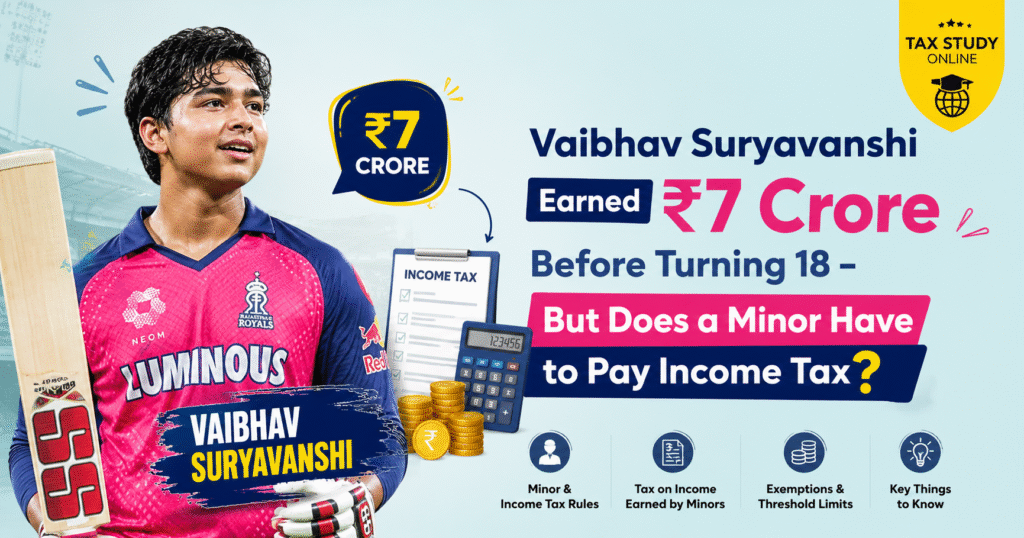
When news broke that teenage cricket sensation Vaibhav Suryavanshi had reportedly earned ₹7 crore before reaching adulthood, it sparked more than just admiration for his talent. It also raised an interesting tax question:
Can a minor be liable to pay income tax in India?
Many people assume that individuals below the age of 18 are exempt from taxation. However, Indian tax laws tell a different story. The answer depends not on the age of the individual but on the source of the income.
Today, young athletes, content creators, actors, and entrepreneurs can earn substantial incomes, making it more important than ever to understand how minors are taxed.
Do Minors Pay Income Tax in India?
Yes, minors can be subject to income tax in India. However, the tax treatment varies based on how the income is earned.
The Income Tax Act generally taxes a minor’s income differently from an adult’s income. In most cases, the law adds a minor’s income to a parent’s income. However, a significant exception applies to income that a minor earns through personal talent, skill, or effort.
Let’s understand the distinction.
General Rule: Parents Must Include a Minor’s Income in Their Own Income
The Income Tax Act contains a provision known as clubbing of income, which applies to most income earned by minors.
According to this rule, a minor’s income is usually added to the income of the parent whose total income is higher. The parent then pays tax on that combined income.
This typically applies to passive income such as:
- Interest earned on savings accounts
- Fixed deposit interest
- Income from investments
- Dividend income
- Rental income from property owned by the minor
- Income generated from assets gifted to the child
The purpose of this provision is simple: to prevent tax avoidance by transferring income-generating assets to children.
In these situations, the minor does not file a separate tax return, and the tax burden falls on the parent.
The Exception That Changes Everything: Skill-Based Income
Although the law generally clubs a minor’s income with the parent’s income, it recognizes that some children earn money through their exceptional talent and hard work.
When a minor earns income through their own skill, knowledge, talent, or specialized ability, the clubbing provisions do not apply.
This means the income is treated independently and taxed in the minor’s own name.
Examples of skill-based income include:
- Professional sports earnings
- Acting and entertainment income
- Singing and performing arts
- Social media content creation
- YouTube revenue
- Brand endorsements
- Prize money from competitions
- Professional consulting based on specialized skills
The logic is straightforward: if an individual generates income through their personal effort and talent, that income belongs to them and should be taxed separately.
Why Vaibhav Suryavanshi’s Income Is Different
Vaibhav Suryavanshi’s earnings reportedly come from sources such as:
- Cricket contracts
- Match fees
- Sponsorship agreements
- Brand endorsements
- Performance-related earnings
These incomes are directly linked to his cricketing ability, dedication, and performance on the field.
Since the income is earned through his personal skill and sporting talent, it qualifies as skill-based income under tax law.
As a result:
- The income is taxed in Vaibhav’s own name.
- It is not clubbed with his parents’ income.
- He may be required to comply with applicable tax provisions.
- Since he is still a minor, his parent or legal guardian will handle tax-related formalities and file the income tax return on his behalf as a representative assessee.
In simple words, despite being under 18, Vaibhav’s earnings are treated as his own taxable income.
Active Income vs Passive Income: The Key Difference
To understand minor taxation, it is important to distinguish between active and passive income.
Passive Income
Passive income is generated from assets, investments, or money that already exists.
Examples include:
- Bank interest
- Fixed deposits
- Mutual fund returns
- Dividends
- Rental income
Such income is generally clubbed with the parent’s income.
Active Income
Active income is generated through personal effort, talent, expertise, or performance.
Examples include:
- Sports contracts
- Acting assignments
- Content creation
- Brand collaborations
- Professional performances
This income is taxed separately in the hands of the minor.
This distinction ensures fairness while preventing misuse of tax-saving arrangements.
Why This Rule Matters More Than Ever Today
A decade ago, it was rare for teenagers to earn significant amounts of money. Today, the landscape has changed dramatically.
Young Indians are building successful careers through:
- Professional sports
- YouTube channels
- Instagram influencing
- Gaming and esports
- Music and entertainment
- Startups and entrepreneurship
- Online education platforms
Many teenagers now earn lakhs – or even crores – before reaching adulthood.
For such individuals and their families, understanding tax obligations is crucial to avoid compliance issues and penalties.
Tax Filing for Minors: How Does It Work?
Although a minor may have taxable income, they cannot independently handle all legal and financial responsibilities.
Therefore:
PAN Card Requirement
A Permanent Account Number (PAN) helps ensure tax compliance and supports financial transactions.
Return Filing
A parent or legal guardian acting as a representative assessee files the income tax return.
Tax Planning
Maintain proper records of contracts, endorsement agreements, invoices, and receipts to support the source of income.
Professional Guidance
For minors earning substantial income through sports, entertainment, or digital platforms, seeking professional tax advice can help ensure compliance and optimize tax planning.
The Bigger Lesson from Vaibhav Suryavanshi’s Story
Vaibhav Suryavanshi’s success highlights an important reality of the modern economy: age does not determine taxability- income does.
The Income Tax Act focuses on the nature and source of earnings rather than the age of the person earning them.
A parent generally pays tax on income a child earns from investments or gifted assets. However, the child pays tax separately on income earned through exceptional talent, hard work, and personal skill.
Final Thoughts
The question of whether Vaibhav Suryavanshi has to pay income tax may seem surprising at first, but the answer illustrates an important principle of Indian taxation.
Yes, minors can pay taxes. However, the tax treatment depends entirely on how they earn the income.
Parents generally club passive income with their own income, while minors pay tax separately on skill-based income. Since Vaibhav’s earnings arise from cricket contracts, match fees, and endorsements driven by his talent and performance, they are taxable in his own name.
As more young Indians achieve remarkable success in sports, entertainment, content creation, and entrepreneurship, understanding these tax rules is becoming increasingly important for parents, professionals, and aspiring young achievers alike.