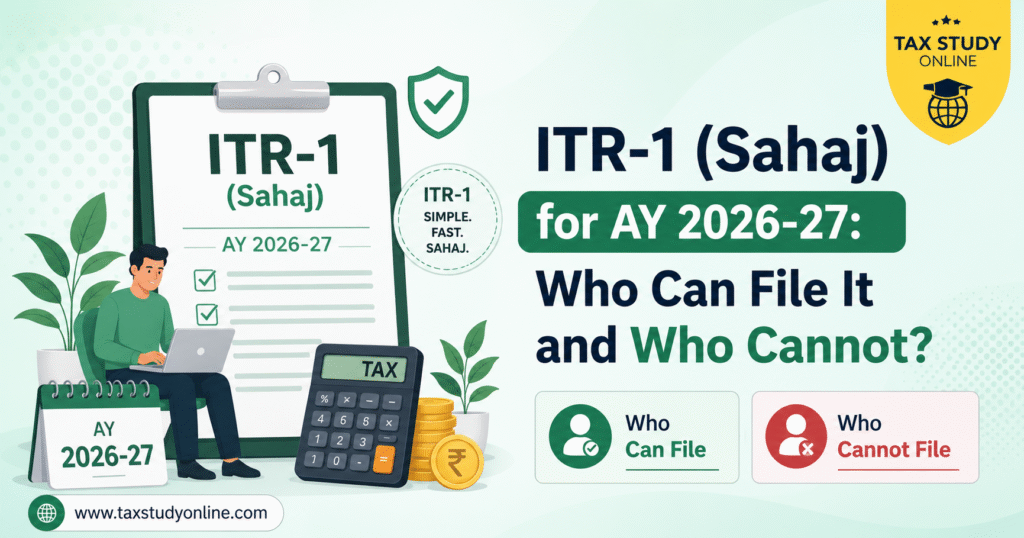
Filing Income Tax Return (ITR) is an important responsibility for every taxpayer, and ITR-1 is the simplest return form designed for salaried individuals and pensioners. If you earn income from salary, pension, up to two house properties, or other sources such as bank interest, ITR-1 can help you report your income to the Income Tax Department easily.
In this article, we explain who can file ITR-1 (Sahaj), the types of income covered under it, and the situations where taxpayers must choose a different ITR form.
What is ITR-1 (Sahaj)?
ITR-1, commonly known as Sahaj, is a simplified return form meant exclusively for resident individuals. It enables taxpayers with simple income structures to file their income tax returns quickly and efficiently.
The form is applicable only when the taxpayer’s total income does not exceed ₹50 lakh during the financial year and the income is earned from specified sources.
Who Can File ITR-1?
You can file ITR-1 if you are:
- A Resident Individual (other than Resident but Not Ordinarily Resident – RNOR).
- Having a total income up to ₹50 lakh.
- Earning income from eligible sources prescribed under the Income Tax Act.
Income Sources Covered Under ITR-1
1. Income from Salary or Pension
Salaried employees and pensioners can use ITR-1 to report income received from:
- Salary
- Pension
- Allowances
- Perquisites
- Retirement benefits
This makes ITR-1 the most commonly used return form among working professionals and retired individuals.
2. Income from Two House Properties
Taxpayers earning income from up to Two house properties can also file ITR-1.
This includes:
- Self-occupied property
- Let-out property
However, if you own more than two house properties, ITR-1 will not be applicable.
3. Income from Other Sources
The form allows reporting income such as:
- Savings account interest
- Fixed deposit interest
- Recurring deposit interest
- Dividend income
- Family pension
- Other similar income taxable under the head “Income from Other Sources”
4. Agricultural Income up to ₹5,000
Individuals with agricultural income not exceeding ₹5,000 during the financial year can continue to use ITR-1.
5. Long-Term Capital Gain Under Section 112A
A notable relief for taxpayers is that ITR-1 can now be used for reporting Long-Term Capital Gains (LTCG) under Section 112A up to ₹1,25,000.
These gains generally arise from the sale of:
- Listed equity shares
- Equity-oriented mutual funds
- Units of business trusts
subject to the applicable provisions of the Income Tax Act.
Who Cannot File ITR-1?
While ITR-1 is simple and convenient, several categories of taxpayers are specifically excluded from using it.
1. Directors of Companies
If you were a director in any company during the financial year, you cannot file ITR-1.
Example: Mr. A was a director in XYZ Pvt. Ltd. and earned a salary of ₹12 lakh. Even though he has only salary income, he must file ITR-2 instead of ITR-1.
2. Taxpayers with Short-Term Capital Gains (STCG)
Individuals earning short-term capital gains from shares, mutual funds, property, or other assets are not eligible for ITR-1.
Example: Ms. B purchased shares in January and sold them in June, earning a profit of ₹30,000. Since this is a short-term capital gain, she cannot use ITR-1.
3. LTCG Under Section 112A Exceeding ₹1,25,000
If your long-term capital gains from listed shares or equity mutual funds exceed ₹1,25,000, ITR-1 cannot be used.
Example: Mr. C earned ₹2 lakh as long-term capital gain from listed shares. As the gain exceeds ₹1,25,000, he must file ITR-2.
4. Holders of Unlisted Equity Shares
Anyone who held shares of a private company (unlisted company) during the year cannot file ITR-1.
Example: Ms. D invested in a startup company that is not listed on any stock exchange. Therefore, she is not eligible for ITR-1.
5. Foreign Assets or Financial Interests
Individuals owning assets or investments outside India cannot use ITR-1.
Example: Mr. E owns a residential apartment in Dubai. Since he has a foreign asset, he must file a different ITR form.
6. Signing Authority in Foreign Accounts
A person who has authority to operate or sign in a foreign bank account is not eligible for ITR-1.
Example: Ms. F works for a multinational company and is authorized to sign cheques from the company’s Singapore bank account. She cannot file ITR-1.
7. Income Earned Outside India
Any income received from foreign sources makes a taxpayer ineligible for ITR-1.
Example: Mr. G received consulting fees from a client in the United States. Since he has foreign-source income, ITR-1 cannot be filed.
8. Cases Covered Under Section 393(3) [ Table Sl No. 5] / Section 194N
Taxpayers from whose cash withdrawals TDS has been deducted under this provision cannot use ITR-1.
Example: Mr. H withdrew ₹1.5 crore in cash from his bank account during the year, and the bank deducted TDS. Therefore, he is not eligible for ITR-1.
9. Deferred Tax on ESOPs
Employees who opted for deferred tax payment on eligible startup ESOPs cannot file ITR-1.
Example: Ms. I exercised ESOPs provided by an eligible startup and deferred the tax liability. Hence, she must choose another ITR form.
10. Brought Forward or Carry Forward Losses
Taxpayers who want to carry forward losses from previous years cannot use ITR-1.
Example: Mr. J incurred a capital loss of ₹50,000 from shares last year and wants to carry it forward for future tax adjustment. Therefore, ITR-1 is not applicable.
11. Total Income Exceeding ₹50 Lakh
Individuals whose total income exceeds ₹50 lakh during the financial year cannot file ITR-1.
Example: Ms. K earned a salary of ₹55 lakh during FY 2025-26. Since her income exceeds ₹50 lakh, she must file ITR-2 or another applicable form.
If you have income from a business or profession under the presumptive taxation scheme, you may need to file ITR-4 instead of ITR-1. Read our complete guide on ITR-4 eligibility and filing.
Why Selecting the Correct ITR Form is Important
Filing your return using the correct form is essential. Using an incorrect ITR form can result in:
- Defective return notices from the Income Tax Department
- Delays in processing returns
- Delays in receiving refunds
- Additional compliance requirements
Therefore, taxpayers should carefully review their income sources and financial transactions before selecting an ITR form.
Final Words
ITR-1 (Sahaj) remains the most convenient return filing option for salaried individuals, pensioners, and taxpayers with simple income structures. If your income comes from salary, two house properties, interest income, and limited agricultural or limited long-term capital gain income under section 112A, you may be eligible to use this simplified form.
However, taxpayers with foreign assets, Long term capital gains under section 112A beyond the prescribed limits, more than two house properties, business income, or carried-forward losses should carefully evaluate the applicable ITR form before filing their return.
Choosing the right ITR form is the first step toward hassle-free tax compliance and timely processing of your income tax return.