
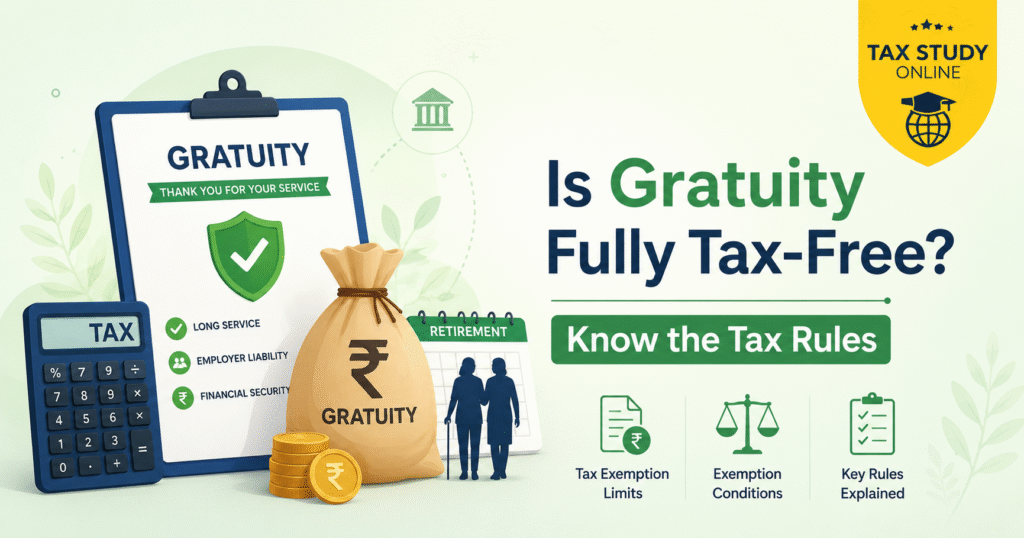
After working for a company for many years, employees may get a gratuity payment when they retire, leave their job, or their employment ends. Many people ask:
“Do I need to pay tax on the gratuity money I receive?”
Many people get confused because gratuity is considered part of “salary” under the Income-tax Act. So, they think the entire gratuity amount will be taxed. However, the Income Tax Act, provides significant tax relief in many cases.
What is Gratuity?
Gratuity is a one-time payment that an employer gives to an employee as a reward for many years of continuous service. It serves as a retirement benefit and helps provide financial support when the employee leaves the job, retires, or their employment ends.
In most cases, an employee becomes eligible to receive gratuity after completing at least five years of continuous service, according to the applicable laws.
Why is gratuity included in “salary” under the Income-tax Act?
For tax purposes, “salary” doesn’t mean only your monthly salary. It also includes other payments you get from your employer, like gratuity.
Gratuity is added under salary so that the tax rules can be applied correctly and it can be checked how much tax is to be paid or exempted.
How Does the Income Tax Act Solve the Problem?
The Income-tax Act understands that gratuity is not regular salary, but a benefit given at the time of retirement or job end.
So, instead of taxing the full amount, the law gives tax exemptions depending on the type of employee and their service rules.
Is Gratuity Taxable?
The answer depends on the category of employee.
Government employees (Central/State/local authority/defence)
- The Government employees get death-cum-retirement gratuity ( DCRG) , under the revised pension rules of the Central Government, or the Central Civil Services (Pension) Rules, 2021 or under any similar scheme applicable
- DCRG = 100% tax-free
Retiring Gratuity for Defence Personnel
- Paid to defence service members on retirement
- Governed by Defence Pension Code / Regulations
- It is a type of government pension-linked gratuity
- It is 100% tax-free
Private Sector Employees Covered Under the Gratuity Act 1972
Gratuity is payable when an employee retires, resigns after completing at least five years of continuous service, becomes disabled, or dies while in service.
It is calculated based on the employee’s last drawn salary and length of service, using the prescribed formula under the Act.
The formula as per Section 4(2) of The payment of Gratuity Act 1972 is given below:
Gratuity Amount =[(Last drawn Basic Salary + Dearness Allowance) × 15 days ÷ 26 days] × Years of Continuous Service
The exempt amount is the lower of the following three:
- Actual gratuity received from the employer
- Gratuity calculated under Section 4(2) of The payment of Gratuity Act 1972 ( i.e. as per above formula)
- ₹20 lakh —Maximum ceiling limit as per section 4(3) of The payment of Gratuity Act 1972
Note: Counting of service period = Completed year of service + part exceeding 6 months counts as full year ( period more than 6 months is rounded up to next year)
Example:
- Job service period is 20 years + 8 months. Since the fraction exceeds 6 months, it is treated as 21 years.
- Job service period is 15 years + 5 months. Since the fraction does not exceeds 6 months, it is treated as 15 years.
Example:
- Last drawn salary (Basic + DA): ₹60,000
- Service period: 20 years
- Gratuity received from employer: ₹10,00,000
Step 1: Calculate gratuity (as per Income Tax formula)
Gratuity = (60,000 × 15 ÷ 26) × 20
= (34,615 × 20)
= ₹6,92,308
Step 2: Compare exemption limits
We take the lower of:
- Actual gratuity received = ₹10,00,000
- Statutory limit = ₹20,00,000
- Formula-based gratuity = ₹6,92,308
Exempt amount = ₹6,92,308
Step 3: Taxable amount
Actual received − exempt amount
= 10,00,000 − 6,92,308
= ₹3,07,692 taxable
Private Sector Employees Not Covered Under the Gratuity Act 1972
Private sector employees who are not covered under the Payment of Gratuity Act, 1972, are still eligible for gratuity but the calculation and tax exemption method is different.
For such employees, gratuity is calculated as per below formula:
Gratuity Amount = ½ × (Average of last 10 months’ Basic Salary + Dearness Allowance) × Completed years of service
The exempt amount is the lower of the following three:
- Actual gratuity received from employer
- Amount Calculated exemption as per above formula
- ₹20 lakh ( Maximum ceiling limit)
Note: Counting of service period = Only completed years are counted. The fraction of year is ignored.
Example:
Job service period is 20 years + 8 months. it is treated as 20 years only. The fraction 8 months are ignored.
Example:
- Average Basic + DA (last 10 months): ₹50,000 per month
- Completed service: 20 years
- Actual gratuity received: ₹6,00,000
Step 1: Calculate gratuity (as per Income Tax formula)
Gratuity = ½ × Average Salary × Complete Years of Service
Average Salary = 10 months basic salary and dearness allowance ÷ 10 month
= ½ × 50,000 × 20
= 25,000 × 20
= ₹5,00,000
Step 2: Apply exemption rule
Exemption is lower of:
- Actual gratuity received = ₹6,00,000
- Statutory limit = ₹20,00,000
- Formula-based gratuity = ₹5,00,000
Exempt amount = ₹5,00,000
Step 3: Taxable amount
₹6,00,000 − ₹5,00,000 = ₹1,00,000 taxable
Summary: Gratuity Tax Exemption Rules
| Employee Category | Tax Treatment |
| Central Government Employees | Fully Exempt |
| State Government Employees | Fully Exempt |
| Local Authority Employees | Fully Exempt |
| Defence Personnel | Fully Exempt |
| Private Employees Covered Under Gratuity Act | Exemption available up to lower of prescribed limits ( as discussed above) |
| Private Employees Not Covered Under Gratuity Act | Exemption available up to lower of prescribed limits ( as discussed above) |
Conclusion
- Gratuity rewards employees for their long-term commitment and service.
- Government employees receive fully tax-free gratuity.
- Private-sector employees can claim tax exemption subject to prescribed limits and conditions.
- The maximum gratuity exemption limit is ₹20 lakh.
- Any amount exceeding the eligible exemption is taxable under the head “Salary.”
- Understanding gratuity tax rules helps you accurately file your ITR and avoid tax-related errors.
FAQs
1. Is gratuity fully tax-free in India?
Not always. Government employees generally receive fully tax-exempt gratuity, while private-sector employees may receive partial exemption based on prescribed limits and calculation methods.
2. What is the maximum gratuity exemption limit?
The maximum gratuity exemption available under the Income Tax Act is ₹20 lakh.
3. Is gratuity taxable for private-sector employees?
Yes, gratuity may be partially taxable if the amount received exceeds the eligible exemption calculated under the Income Tax Act.
4. How to Calculate Gratuity Under the Payment of Gratuity Act, 1972?
The formula is:
[(Last Drawn Basic Salary + DA) × 15 days ÷ 26 days ] × Years of Continuous Service
5. Is gratuity received on retirement taxable?
It depends on the employee category and applicable exemption. Government employees usually receive fully tax-free gratuity, while private employees may have a taxable portion.
6. Do I need to report gratuity in my Income Tax Return?
Yes. Gratuity received should be reported in your ITR, and the eligible exemption should be claimed as per the applicable provisions of the Income Tax Act.

