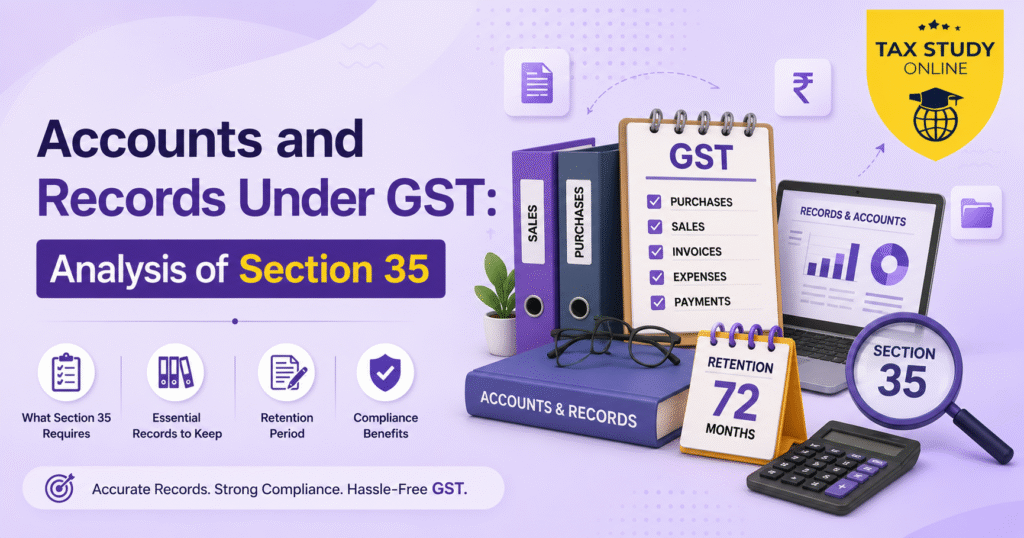
The Goods and Services Tax (GST) system in India is built on transparency, accountability, and proper documentation. One of the most important compliance requirements under GST is the maintenance of proper books of accounts and records. To ensure systematic compliance, Section 35 of the Central Goods and Services Tax (CGST) Act, 2017 lays down detailed provisions regarding the maintenance, preservation, and production of accounts and records by registered persons.
Maintaining accurate records is not only essential for GST return filing but also plays a crucial role during departmental audits, assessments, investigations, and Input Tax Credit (ITC) verification. Non-maintenance or incorrect maintenance of records may lead to penalties, tax demands, and litigation.
This blog provides a comprehensive analysis of Section 35 of the CGST Act along with relevant GST Rules, practical implications, and compliance requirements in simple language.
Understanding Section 35 of the CGST Act
Section 35 primarily deals with:
- Maintenance of books of accounts
- Place where records should be maintained
- Types of records required
- Electronic maintenance of records
- Additional requirements for specific taxpayers
- Consequences of non-compliance
- Retention period of records
The provisions of Section 35 are supported by Rules 56, 57, and 58 of the CGST Rules, 2017.
1. Who is Required to Maintain Books of Accounts?
Under Section 35(1), every registered person under GST is required to maintain proper books of accounts and records.
This requirement applies to:
- Manufacturers
- Traders
- Service providers
- Works contractors
- Agents
- Warehouse operators
- Transporters
- Clearing and forwarding agents
Essentially, every person registered under GST must maintain records in the prescribed manner.
2. Place Where Books of Accounts Must Be Maintained
Principal Place of Business (PPoB)
Every registered taxpayer must maintain books of accounts at the Principal Place of Business mentioned in the GST Registration Certificate.
The Principal Place of Business refers to the primary location from where business operations are conducted.
Additional Place of Business (APoB)
If a taxpayer operates from multiple locations, all such places must be declared as Additional Places of Business in GST registration.
Books relating to each place of business must generally be maintained at the respective location itself.
For example:
- A company having offices in Delhi, Mumbai, and Bengaluru must maintain records relating to each location at those respective places.
This ensures transparency and facilitates physical verification by GST authorities.
3. Special Provisions for Auction-Based Goods
Certain sectors such as:
- Tea industry
- Coffee trade
- Rubber industry
operate through auctions and warehouses spread across multiple locations. Maintaining records at each warehouse creates practical difficulties.
To address this issue, the GST department issued clarifications permitting flexibility in maintenance of records.
Warehouses as Additional Place of Business
In auction-based transactions:
- The principal and auctioneer may declare warehouses as APoB.
- Buyers storing auction-purchased goods in such warehouses must also declare them as APoB.
This applies to:
- Auction-based supplies
- Private treaty transactions of tea
Maintenance of Records at Principal Place of Business
The principal and auctioneer may maintain books of accounts relating to APoB at the Principal Place of Business instead of every warehouse location.
However, they must:
- Inform the jurisdictional GST officer in writing regarding this arrangement.
Eligibility of Input Tax Credit (ITC)
The GST department clarified through Circular No. 23/23/2017-GST and Circular No. 47/21/2018-GST that:
- Principals and auctioneers remain eligible to claim ITC,
- Subject to fulfillment of all other GST conditions.
This clarification was extremely important for auction-based industries where goods move through multiple storage points.
4. Presumption Regarding Undeclared Records
GST law provides that if any books of accounts, registers, or documents are found at premises not declared in GST registration, they shall be presumed to belong to the registered person unless proven otherwise.
This provision strengthens departmental powers during:
- Search operations
- Inspection
- Investigation
- Anti-evasion proceedings
Hence, businesses must ensure:
- Proper declaration of all business premises
- Correct storage of records
- Valid documentation for movement and storage of goods
5. Accounts and Records Required Under GST
Every registered person must maintain true and correct accounts of the following:
(a) Production or Manufacture of Goods
Manufacturers must maintain detailed production records including:
- Quantity of raw materials consumed
- Quantity manufactured
- Waste generated
- By-products produced
These records help GST authorities verify production-output ratios and tax liability.
(b) Inward and Outward Supply of Goods or Services
Businesses must maintain complete records of:
Inward Supplies
- Purchases
- Services received
- Import transactions
Outward Supplies
- Sales
- Services provided
- Exports
These records form the basis for GST return filing and ITC claims.
(c) Stock of Goods
Stock records must contain complete details of:
- Opening stock
- Goods received
- Goods supplied
- Closing stock
- Goods in transit
- Scrap and wastage
Stock records are extremely important during GST audits and physical verification.
(d) Input Tax Credit Availed
Every registered person must maintain records of:
- ITC claimed
- Eligible ITC
- Reversed ITC
- Blocked credits
Improper ITC documentation is one of the major causes of GST notices and disputes.
(e) Output Tax Payable and Paid
Businesses must maintain records showing:
- Tax liability
- Tax payments
- Reverse charge liability
- Interest paid
- Late fees
These records help reconcile GST returns with books of accounts.
(f) Other Prescribed Particulars
Additional records prescribed under GST Rules must also be maintained.
6. Power of Commissioner to Require Additional Records
Under Section 35(3), the Commissioner may notify certain classes of taxpayers to maintain additional accounts or documents.
This power is generally exercised for:
- High-risk industries
- Sectors prone to tax evasion
- Businesses involving large movement of goods
For example:
- E-commerce operators
- Large manufacturers
- Petroleum-related businesses
may be asked to maintain additional documentation.
7. Relaxation in Maintenance of Accounts
Under Section 35(4), if certain taxpayers are unable to maintain records in the prescribed format, the Commissioner may permit maintenance in an alternative manner.
Such permission:
- Must be granted in writing,
- Requires proper reasons to be recorded.
This provision is beneficial for sectors with unique operational structures.
8. Additional Records Required Under GST Rules
Rule 56 of the CGST Rules prescribes detailed record-keeping requirements.
(i) Additional Requirements for Registered Persons
Apart from general records, taxpayers must maintain details relating to:
Import and Export Transactions
Complete records of:
- Imported goods/services
- Exported goods/services
- Shipping bills
- Bill of entry
- Export invoices
must be maintained.
Reverse Charge Supplies
Taxpayers must maintain records of supplies liable to Reverse Charge Mechanism (RCM), along with:
- Tax invoices
- Payment vouchers
- Self-invoices
- Debit notes
- Credit notes
RCM transactions are heavily scrutinized under GST.
Advances Received and Paid
Separate accounts must be maintained for:
- Advances received from customers
- Advances paid to suppliers
- Adjustments against such advances
This helps determine GST liability on advances wherever applicable.
Supplier and Customer Details
Businesses must maintain:
- Names of suppliers
- Complete addresses
- GSTIN details
- Customer details
This helps authorities verify transaction genuineness.
Details of Storage Premises
Taxpayers must maintain details of all premises where goods are stored, including:
- Warehouses
- Godowns
- Transit locations
along with stock details.
Consequences of Undeclared Storage
If goods are found at undeclared locations without valid documents:
- The proper officer may treat them as unaccounted supplies,
- And determine GST liability accordingly.
This can lead to:
- Tax demands
- Penalties
- Seizure proceedings
9. Stock Records Under GST
Every supplier, except composition taxpayers, must maintain detailed stock records.
Stock Register Must Include
- Opening stock
- Goods received
- Goods supplied
- Goods lost
- Goods stolen
- Goods destroyed
- Goods written off
- Goods distributed as free samples
- Closing stock
The stock register should also separately show:
- Raw materials
- Finished goods
- Scrap
- Wastage
Proper stock maintenance is one of the most important compliance requirements under GST.
10. Tax Records Under GST
Businesses must maintain records showing:
- Output tax payable
- Reverse charge liability
- Tax collected
- Tax paid
- ITC claimed
In addition, records of the following documents must be preserved:
- Tax invoices
- Debit notes
- Credit notes
- Delivery challans
11. Records to be Maintained by Agents
Every GST agent must maintain records showing:
- Authorization from principals
- Goods/services received on behalf of principals
- Goods/services supplied on behalf of principals
- Accounts furnished to principals
- Tax paid on behalf of principals
These records are necessary to establish principal-agent relationships under GST.
12. Records to be Maintained by Manufacturers
Manufacturers must maintain monthly production accounts containing:
- Raw material consumption
- Production quantity
- Waste generation
- By-products
This helps authorities verify:
- Manufacturing efficiency
- Input-output ratio
- Tax compliance
13. Records to be Maintained by Service Providers
Service providers must maintain records showing:
- Input services utilized
- Goods used in providing services
- Services supplied
These records are particularly important for sectors like:
- Consulting
- IT services
- Construction services
- Repair services
14. Records for Works Contractors
Works contractors must maintain separate accounts showing:
- Contract-wise details
- Names and addresses of clients
- Materials received
- Materials utilized
- Payments received
- Supplier details
Works contract transactions are complex under GST and therefore require detailed documentation.
15. Records for Clearing & Forwarding Agents
Clearing and forwarding agents or carriers handling goods on behalf of registered persons must maintain proper records relating to:
- Goods received
- Goods dispatched
- Delivery details
These records must be produced whenever demanded by GST authorities.
16. Records for Warehouse Owners and Transporters
Warehouse operators and transporters must maintain records relating to:
- Consignor
- Consignee
- Goods movement
- Storage period
- Dispatch and receipt details
Enrollment Requirement
If such persons are not registered under GST, they must obtain a Unique Enrollment Number through Form GST ENR-01.
Once enrolled:
- The enrollment becomes valid across India,
- But they cannot use GSTIN unless separately registered.
17. Maintenance of Records in Electronic Form
GST law permits electronic maintenance of records.
Digital Storage of Records
Books of accounts may be maintained electronically on:
- Computers
- Servers
- Cloud systems
- Digital storage devices
Digital Authentication
Electronic records must be authenticated using:
- Digital Signature Certificate (DSC)
- Electronic verification methods
Backup Requirement
Proper electronic backup must be maintained so records can be restored in case of:
- Fire
- Flood
- System failure
- Cyber incidents
Production of Records on Demand
Taxpayers must provide records:
- In hard copy, or
- Electronically readable format
whenever required by GST authorities.
Passwords and Access Information
If records are digitally stored, the taxpayer must provide:
- Passwords
- Access credentials
- File details
- Explanations of codes used
when demanded during investigation or audit.
18. Restriction on Alteration of Records
GST law strictly prohibits:
- Erasing entries
- Overwriting records
- Manipulating books of accounts
Incorrect entries must:
- Be struck out properly,
- Authenticated by the taxpayer,
- Followed by correct entries.
For electronic records, a proper audit trail or edit log must be maintained.
19. Production of Books Under Other Laws
GST authorities may also require taxpayers to produce books maintained under other laws such as:
- Companies Act
- Income Tax Act
- Customs Act
This helps authorities conduct cross-verification.
20. Consequences of Failure to Maintain Accounts
Failure to maintain proper accounts can result in severe consequences.
If goods or services are not properly accounted for, the proper officer may:
- Determine tax liability,
- Treat such goods/services as deemed supplies,
- Initiate proceedings under:
- Section 73
- Section 74
- Section 74A
depending upon the nature of default.
Possible Consequences Include
- Tax demand
- Interest liability
- Penalty
- Confiscation of goods
- GST audit
- Investigation proceedings
Improper documentation is one of the most common reasons for GST disputes.
21. Period of Retention of Accounts Under Section 36
Standard Retention Period
Every registered person must preserve books of accounts and records for:
72 months (6 years)
from the due date of filing the annual return for the relevant financial year.
Retention During Litigation or Investigation
If the taxpayer is involved in:
- Appeal
- Revision
- Tribunal proceedings
- Court case
- Investigation
then records must be retained for:
- One year after final disposal, or
- The normal retention period,
whichever is later.
Practical Importance of Proper GST Record Maintenance
Proper maintenance of records helps businesses:
- Avoid GST penalties
- Ensure smooth audits
- Claim ITC without disputes
- Reconcile returns properly
- Prevent litigation
- Improve internal control systems
In today’s digital GST environment, proper documentation is one of the most critical compliance requirements for every business.
Conclusion
Section 35 of the CGST Act serves as the foundation of GST compliance by mandating systematic maintenance of books of accounts and records. The provisions ensure transparency, facilitate tax administration, and reduce tax evasion.
Every registered taxpayer must establish a strong accounting and documentation system to comply with GST requirements effectively. With increasing departmental scrutiny and data analytics under GST, businesses can no longer afford poor record management practices.
Proper maintenance and preservation of accounts not only help avoid penalties and litigation but also support smooth business operations and long-term compliance under the GST regime.