Do you believe that earning below the taxable limit means you never need to file an Income Tax Return (ITR)? Or that choosing the new tax regime is always the best option?
These are common income tax misconceptions that can lead to confusion, missed refunds, and avoidable compliance issues.
Understanding the facts can help you manage your tax responsibilities, choose the right tax regime, and make informed financial decisions.
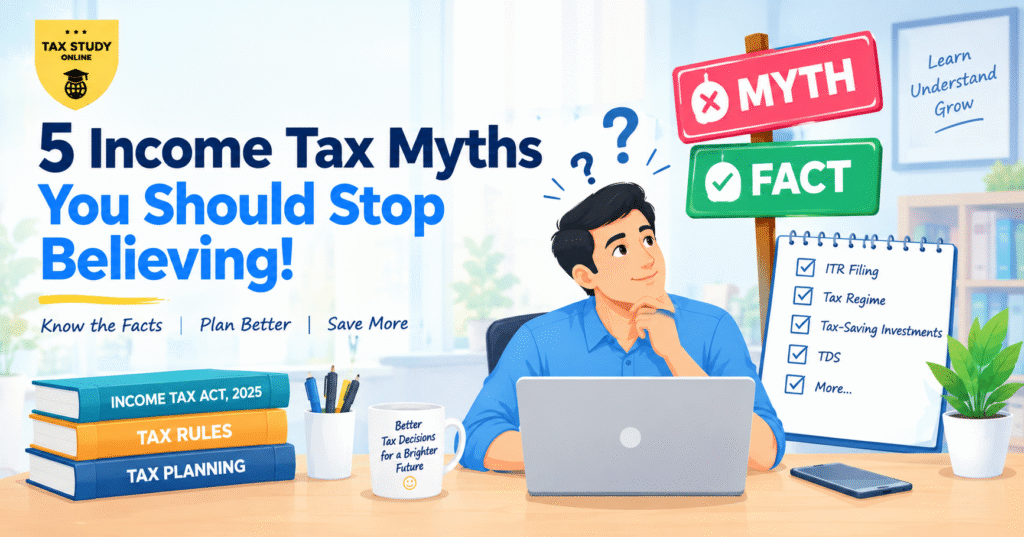
Let’s explore five income tax myths you should stop believing!
Myth 1: If Your Income Is Below the Taxable Limit, You Never Need to File an ITR
Fact: Certain taxpayers may need to file an ITR even when their income is below the applicable taxable limit.
The requirement to file an Income Tax Return does not depend only on whether you have tax to pay. Your income, financial transactions, and other circumstances may also determine whether filing is mandatory.
For example, specific filing conditions may apply to individuals who meet prescribed criteria relating to foreign assets, certain high-value transactions, or other circumstances covered by income tax law.
Additionally, some people choose to file an ITR even when their income is below the taxable limit because they need to claim a tax refund, document their income, or maintain financial records.
What should you do?
- Check whether your income and circumstances require mandatory filing.
- Review applicable filing conditions under the relevant tax year’s law.
- File an ITR when required, even if your final tax liability is zero.
Myth 2: Choosing the New Tax Regime Is Always Better
Fact: The better tax regime depends on your income, eligible deductions, exemptions, and overall financial situation.
India provides two tax regimes for eligible taxpayers: the new tax regime and the old tax regime.
The new tax regime is the default regime under the Income-tax Act, 2025. However, eligible taxpayers may choose the old tax regime in accordance with the applicable rules.
Here is a general comparison:
| Feature | New Tax Regime | Old Tax Regime |
| Tax rates and slabs | Different rate structure | Different rate structure |
| Eligible deductions | Generally more limited | More deductions may be available |
| Tax-saving investments | Many traditional deductions are unavailable | Eligible deductions may be claimed |
| Best option | Depends on individual circumstances | Depends on individual circumstances |
For example, a taxpayer with fewer eligible deductions may find the new regime more beneficial. Someone with substantial eligible deductions and exemptions may benefit from comparing the old regime before making a decision.
What should you do?
Calculate your tax liability under both regimes before choosing. Consider your income, eligible deductions, exemptions, and any applicable restrictions.
Myth 3: Tax-Saving Investments Are Mandatory for Everyone
Fact: You do not have to make tax-saving investments simply because you earn an income.
Many taxpayers invest in eligible instruments to claim deductions under the old tax regime. However, these investments are not compulsory for every taxpayer.
The deductions available to you depend on the tax regime you select and the provisions applicable to your circumstances.
Under the new tax regime, many deductions and exemptions available under the old regime are not permitted, although certain specified deductions remain available.
For example, investing in an eligible instrument solely to claim a deduction may not provide a tax benefit if that deduction is unavailable under your chosen regime.
What should you do?
- Review your financial goals before making an investment.
- Confirm whether the investment qualifies for a deduction.
- Check whether that deduction is available under your chosen tax regime.
- Compare the potential tax benefit with your broader financial needs.
Remember, investment decisions should support your financial goals, not just your tax planning.
Myth 4: Filing an ITR Means You Have to Pay Tax
Fact: You can file an ITR even when no additional tax is payable.
Filing an Income Tax Return and paying income tax are two different responsibilities.
An ITR reports relevant income, deductions, tax payments, and other required information to the Income Tax Department. The return may show that no tax is payable after applying the relevant provisions, eligible deductions, rebates, and tax credits.
You may also file an ITR to claim a refund when tax deducted at source (TDS) or other eligible tax payments exceed your final tax liability.
Example
Suppose an employer deducts ₹30,000 as TDS from an employee’s salary during the tax year.
After calculating the employee’s final tax liability and eligible tax benefits, the amount payable is ₹20,000.
In this simplified example, the employee may be eligible to claim a refund of ₹10,000, subject to the return being correctly filed and the refund claim being accepted.
The example illustrates why filing a return does not automatically mean paying additional tax.
What should you do?
Calculate your final tax liability, reconcile the tax already paid, and check whether you need to pay more tax or are eligible for a refund.
Myth 5: Once TDS Is Deducted, Your Tax Responsibilities Are Over
Fact: TDS is a tax credit, but it does not automatically complete all your tax obligations.
Tax Deducted at Source (TDS) is tax deducted by a payer, such as an employer or bank, and deposited with the government according to the applicable rules.
Although TDS helps collect tax during the year, it may not cover your entire tax liability.
For example, you may have additional income from bank interest, rent, capital gains, or other sources. Your final tax calculation must account for your relevant income and eligible tax credits.
Depending on your circumstances, you may need to:
- File an ITR if filing is mandatory or you choose to file.
- Pay additional tax if your total tax liability exceeds the tax already paid.
- Claim a refund if eligible tax payments exceed your final liability.
- Check the accuracy of your TDS information and reconcile it with your records.
The Income Tax Department also explains that taxpayers should disclose relevant income and claim the appropriate TDS credit in their returns.
What should you do?
Review your Form 16, Form 16A where applicable, Form 26AS, Annual Information Statement (AIS), and other relevant financial records. Verify the tax credits and calculate your final tax liability before filing.
Why Is It Important to Understand These Income Tax Myths?
Believing common tax myths can lead to missed filing requirements, unsuitable tax choices, and missed refund opportunities.
Understanding the rules can help you:
- Stay compliant: Identify whether you are required to file an ITR.
- Choose wisely: Compare tax regimes based on your circumstances.
- Plan investments: Avoid making investments solely because of an assumed tax benefit.
- Claim eligible refunds: Reconcile tax payments with your final liability.
- Maintain accurate records: Keep your income and tax information organised.
Tax planning is not just about reducing tax. It is also about understanding your obligations and making informed financial decisions.
Conclusion
Income tax rules can seem complicated, but understanding the facts behind common myths makes them easier to manage.
Remember these five points:
- Income below the taxable limit does not always mean filing is unnecessary.
- The new tax regime is not automatically the best choice for everyone.
- Tax-saving investments are not compulsory for all taxpayers.
- Filing an ITR does not necessarily mean you owe tax.
- TDS deduction does not automatically complete your tax responsibilities.
Make informed tax decisions, verify your filing requirements, and review your tax liability before submitting your return.
Frequently Asked Questions
1. Can I skip filing an ITR if my income is below the taxable limit?
Not always. Certain filing conditions may require you to submit an ITR even if your income is below the applicable threshold. Check the rules relevant to your tax year and circumstances.
2. Is the new tax regime better than the old tax regime?
Not for everyone. The better option depends on your income, applicable tax rates, eligible deductions, exemptions, and other circumstances. Compare your tax liability under both regimes before deciding.
3. Do I have to invest in tax-saving instruments to reduce my tax?
No. Tax-saving investments are not mandatory for every taxpayer. Whether a particular investment provides a deduction depends on the applicable law and your chosen tax regime.
4. Can I file an ITR if my tax liability is zero?
Yes. You may file an ITR when no tax is payable, depending on your circumstances. Filing may also be necessary to comply with applicable requirements or claim an eligible refund.
5. If my employer deducts TDS, do I still need to file an ITR?
TDS deduction does not automatically remove your filing obligations. You may still need to file a return, pay additional tax, or claim a refund, depending on your circumstances.