Filing an Income Tax Return (ITR) requires taxpayers to report their income accurately and claim only eligible deductions and expenses. However, errors, missing information, or incorrect claims can result in a difference between the income reported and the income assessed by the tax authorities.
Two important concepts in this context are under-reporting of income and misreporting of income.
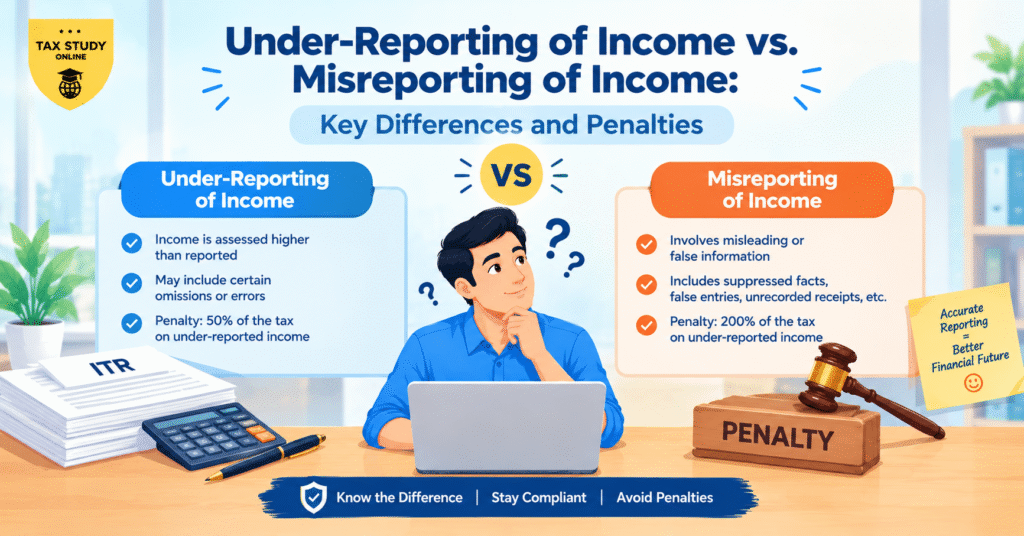
Although these terms are related, they do not mean the same thing. Under-reporting generally refers to income that is assessed at a higher amount than the income reported or previously assessed in circumstances covered by law. Misreporting involves specified forms of inaccurate or misleading reporting, such as suppressing facts or recording false entries.
Under Section 439 of the Income-tax Act, 2025, penalties may apply to under-reported income. The penalty can be significantly higher when the under-reporting results from misreporting. <Cite refs={[“turn595444search16″,”turn595444search17”]}/>
Let’s understand the difference, examples, and ways to maintain accurate tax records.
What Is Under-Reporting of Income?
Under-reporting of income occurs when a taxpayer’s income is assessed at a higher amount than the amount reported or determined previously, as specified under the applicable provisions.
Section 439 of the Income-tax Act, 2025, sets out the circumstances in which income is considered under-reported.
These circumstances may include:
- Assessed income exceeding the income determined when the return was processed.
- Assessed income exceeding the applicable non-taxable threshold in certain cases where no return was filed.
- Reassessed income exceeding the income determined in the immediately preceding assessment or reassessment.
- An assessment or reassessment that reduces a reported loss or converts that loss into income.
The precise treatment depends on the circumstances and the statutory rules. A difference in figures does not, by itself, establish that a taxpayer has deliberately concealed income. The law also specifies circumstances in which an amount is excluded from under-reporting. <Cite refs={[“turn595444search16″,”turn595444search0”]}/>
Examples of Under-Reporting of Income
Example 1: Interest Income Not Included
A taxpayer reports salary income but accidentally leaves out interest earned from a bank deposit. During assessment, the omitted interest is identified and the assessed income increases.
Depending on the facts and applicable provisions, this may result in under-reporting of income.
Example 2: Income Reported at a Lower Amount
A business owner reports income of ₹8,00,000, but the income assessed under the applicable provisions is ₹9,50,000.
The difference of ₹1,50,000 may constitute under-reported income, subject to the statutory rules and the facts of the case.
Example 3: Loss Reduced During Assessment
A taxpayer reports a business loss. During assessment, the tax authority determines that the allowable loss is lower than the amount reported.
If the assessment reduces the reported loss or converts it into income, the under-reporting provisions may apply.
What Is Misreporting of Income?
Misreporting of income refers to specified forms of inaccurate, misleading, or unsupported reporting that result in under-reported income.
Section 439(11) of the Income-tax Act, 2025, identifies circumstances that qualify as misreporting. These include:
- Misrepresentation or suppression of facts: Providing misleading information or withholding material facts.
- Failure to record investments: Not recording investments in the books of account where required.
- Unsupported expenditure claims: Claiming expenses without supporting evidence.
- False entries in books: Recording false entries in accounting records.
- Unrecorded receipts: Failing to record receipts that affect total income.
- Certain unreported transactions: Failing to report international transactions or specified domestic transactions covered by the applicable transfer-pricing provisions.
- Other specified cases: The Act also includes a reference to income covered by Section 195(1)(b).
These categories are set out in the legislation. Whether a penalty applies depends on the facts, the relevant statutory conditions, and the assessment proceedings. <Cite refs={[“turn595444search17″,”turn595444search0”]}/>
Examples of Misreporting of Income
Example 1: Claiming Expenses Without Evidence
A business claims ₹2,00,000 in expenses but cannot substantiate the expenditure with the required evidence.
If the claim falls within the statutory category of unsupported expenditure and results in under-reported income, the misreporting provisions may apply.
Example 2: Recording False Business Entries
A business records fictitious expenses to reduce its reported profit.
False entries in the books of account are expressly identified as a form of misreporting under Section 439(11).
Example 3: Suppressing Business Receipts
A business receives payments from customers but deliberately omits those receipts from its books and tax reporting.
If the omission meets the statutory conditions, it may constitute misreporting of income.
Under-Reporting vs. Misreporting of Income: Key Differences
| Basis | Under-Reporting of Income | Misreporting of Income |
| Meaning | Income falls within the statutory definition of under-reporting | Specified inaccurate or misleading reporting that results in under-reporting |
| Nature | May arise from different circumstances, including certain errors or omissions | Involves conduct or reporting practices covered by the statutory misreporting categories |
| Examples | Income assessed higher than reported; a reported loss reduced during assessment | Suppression of facts, false entries, unrecorded receipts, or unsupported expenditure claims |
| Penalty under Section 439 | 50% of the tax payable on under-reported income | 200% of the tax payable on under-reported income when under-reporting results from misreporting |
| Legal treatment | Subject to the statutory definitions and exclusions | Subject to the specific misreporting provisions and relevant facts |
The main distinction is that misreporting is a specified category of under-reporting that attracts a higher penalty. Not every discrepancy or adjustment automatically qualifies as misreporting. <Cite refs={[“turn595444search16″,”turn595444search17”]}/>
What Are the Penalties for Under-Reporting and Misreporting of Income?
Section 439 of the Income-tax Act, 2025, provides for penalties in addition to any tax payable on under-reported income.
1. Penalty for Under-Reporting
Under Section 439(9), the penalty is generally 50% of the tax payable on the under-reported income.
2. Penalty for Misreporting
Under Section 439(10), where under-reported income results from misreporting, the penalty is 200% of the tax payable on the under-reported income. <Cite refs={[“turn595444search0″,”turn595444search17”]}/>
Illustrative Calculation
Suppose the tax payable on the under-reported income is determined to be ₹40,000.
| Particulars | Calculation | Penalty |
| Under-reporting | ₹40,000 × 50% | ₹20,000 |
| Misreporting | ₹40,000 × 200% | ₹80,000 |
These figures illustrate the penalty rates only. They do not calculate the underlying tax liability, interest, or any other applicable amount. The actual tax payable on under-reported income must be calculated according to Section 439 and the relevant facts.
Important: The penalty is calculated on the tax payable on under-reported income, not automatically on the entire amount of omitted income. The Act also contains exclusions and specific calculation rules. <Cite refs={[“turn595444search16″,”turn595444search17”]}/>
How Can Taxpayers Avoid Under-Reporting and Misreporting?
Accurate records and careful return preparation can help reduce the risk of reporting errors.
1. Report Income From All Relevant Sources
Review salary, business or professional income, bank interest, rental income, capital gains, and other relevant receipts before filing your ITR.
2. Reconcile Your Tax Information
Compare your income and tax records with relevant documents, including Form 16, Form 16A where applicable, Form 26AS, and the Annual Information Statement (AIS).
Investigate discrepancies before submitting your return.
3. Keep Supporting Documents
Maintain invoices, receipts, bank statements, investment records, and other documents that support your income figures and expense claims.
4. Claim Only Eligible Deductions and Expenses
Check the applicable eligibility conditions before claiming a deduction, exemption, or business expense. Do not claim an expense simply because it may reduce taxable income.
5. Maintain Accurate Books of Account
Business owners and professionals should record receipts, investments, expenses, and other relevant transactions accurately.
6. Review Your ITR Before Submission
Check income figures, deductions, tax credits, bank details, and supporting information before filing. Correct genuine mistakes using the appropriate procedure available under the law.
7. Respond Carefully to Tax Notices
If the tax department raises a query or issues a notice, review the information requested and respond within the applicable deadline. Provide relevant documents and a clear explanation of any discrepancy.
Conclusion
Under-reporting and misreporting of income are important concepts in tax compliance. Although both can lead to penalties, the applicable treatment differs depending on the circumstances.
Under Section 439 of the Income-tax Act, 2025, the general penalty is 50% of the tax payable on under-reported income. When the under-reporting results from misreporting, the penalty rises to 200% of that tax amount.
Taxpayers can reduce the risk of compliance issues by reporting income accurately, maintaining proper records, claiming only eligible expenses and deductions, and reviewing their ITR before filing.
FAQs
1. What is the difference between under-reporting and misreporting of income?
Under-reporting refers to circumstances covered by law in which assessed income exceeds the income reported or previously determined. Misreporting involves specified forms of inaccurate or misleading reporting that result in under-reported income.
2. Which section of the Income-tax Act, 2025, deals with these penalties?
Section 439 of the Income-tax Act, 2025, deals with penalties for under-reporting and misreporting of income.
3. What is the penalty for under-reporting of income?
Under Section 439(9), the penalty is generally 50% of the tax payable on under-reported income, subject to the applicable statutory provisions.
4. What is the penalty for misreporting of income?
Under Section 439(10), the penalty is 200% of the tax payable on under-reported income when the under-reporting results from misreporting.
5. Does every mistake in an ITR lead to a penalty?
No. The legal treatment depends on the nature of the mistake, the facts, the applicable provisions, and any relevant exclusions. Taxpayers should correct genuine errors using the appropriate legal procedure and retain supporting documents.