
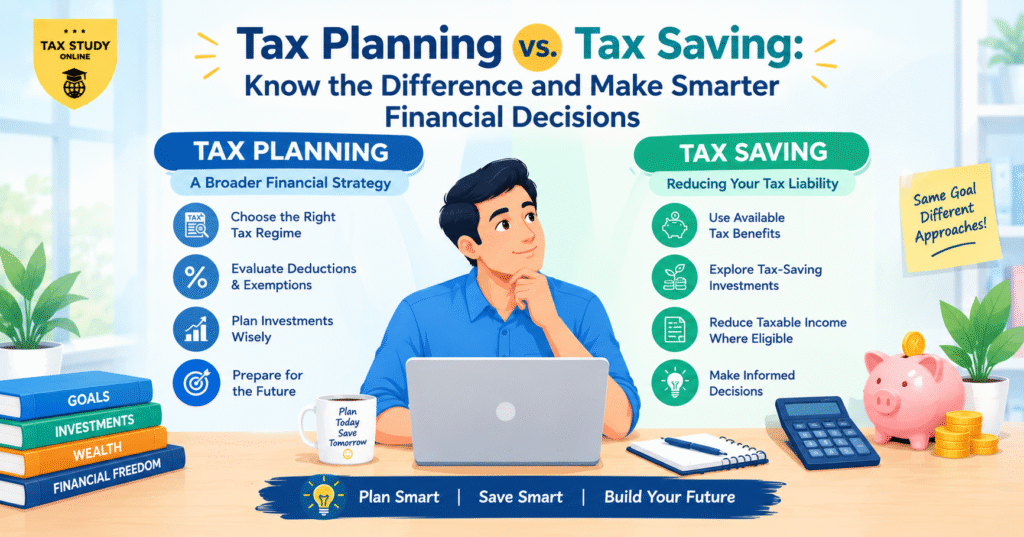
Do you think tax planning and tax saving mean the same thing? Although these terms are closely related, they serve different purposes.
Tax planning is a broader financial strategy, while tax saving focuses specifically on reducing your tax liability through eligible provisions.
Many taxpayers focus on investments and deductions only when the tax-filing deadline approaches. However, effective tax planning begins much earlier. It considers your income, expenses, financial goals, investment choices, and applicable tax rules throughout the tax year.
Understanding the difference between tax planning and tax saving can help you make informed decisions, avoid unnecessary investments, and manage your finances more effectively.
Let’s explore both concepts in detail.
What Is Tax Planning?
Tax planning involves organising your financial activities to manage your tax liability legally while supporting your short-term and long-term financial goals.
It is not limited to reducing taxes. It also involves choosing the appropriate tax regime, reviewing eligible deductions, planning investments, and preparing for future financial needs.
Key Elements of Tax Planning
1. Choose the Right Tax Regime
India’s old and new tax regimes have different tax rates and deduction rules. The new tax regime is the default regime, but eligible taxpayers may be able to choose the old regime subject to applicable conditions.
Comparing your tax liability under both regimes can help you identify the more suitable option.
2. Evaluate Eligible Deductions and Exemptions
Review the deductions and exemptions available under the regime you choose. Do not assume that every deduction available under the old regime is also available under the new regime.
3. Align Investments With Financial Goals
Investment decisions should consider your financial objectives, risk tolerance, expected returns, and liquidity needs. Tax benefits can be one factor in the decision, but they should not be the only consideration.
4. Plan Throughout the Tax Year
Review your salary, additional income, expenses, investments, and tax payments regularly. This can help you avoid last-minute decisions and unexpected tax liabilities.
5. Prepare for Future Financial Needs
Good tax planning considers retirement, education, homeownership, emergency savings, and other financial priorities alongside your tax obligations.
What Is Tax Saving?
Tax saving refers to reducing your tax liability by using deductions, exemptions, rebates, and other benefits permitted under the applicable tax laws.
It is one component of tax planning rather than a complete financial strategy.
For example, an eligible taxpayer under the old tax regime may qualify for certain deductions on approved investments or contributions, subject to the applicable limits and conditions.
However, the availability of a tax benefit depends on the taxpayer’s circumstances and the relevant provisions.
Key Ways to Save Tax Legally
1. Use Eligible Deductions
Identify deductions available under your chosen tax regime. Check the applicable limits, eligibility requirements, and supporting documentation before claiming them.
2. Consider Suitable Tax-Saving Investments
Certain eligible investments may provide tax benefits under the old tax regime. Before investing, review the associated risks, lock-in periods, liquidity, and expected returns.
3. Claim Applicable Exemptions and Rebates
Check whether you qualify for any applicable exemptions or rebates. These benefits have specific eligibility conditions and may differ depending on the tax regime.
4. Review Your Tax Payments
Check TDS, advance tax, and other eligible tax credits. Accurate reconciliation helps you determine whether additional tax is payable or a refund may be due.
5. Maintain Proper Records
Keep investment proofs, salary documents, interest certificates, and other relevant records. Proper documentation supports accurate tax calculations and claims.
Tax Planning vs. Tax Saving: What’s the Difference?
| Basis | Tax Planning | Tax Saving |
| Meaning | A broader strategy for managing tax liability and finances | Actions that reduce tax liability through eligible provisions |
| Main objective | Support financial goals while managing taxes | Reduce the amount of tax payable |
| Scope | Income, tax regime, investments, expenses, and future goals | Eligible deductions, exemptions, rebates, and tax benefits |
| Time frame | Usually considered throughout the tax year and over the long term | Often focuses on specific tax-saving opportunities |
| Investment approach | Based on financial goals, risk, liquidity, and tax implications | May include investments that qualify for specific tax benefits |
| Flexibility | Considers a range of financial decisions | Depends on the available tax benefits and eligibility conditions |
| Relationship | Includes tax saving as one component | Forms one part of tax planning |
The key difference: Tax planning looks at your overall financial picture, while tax saving focuses on reducing tax through permitted benefits.
Example: Tax Planning vs. Tax Saving
Consider two taxpayers, Rahul and Amit. Both want to manage their tax liability, but they approach the task differently.
Rahul: Focuses Only on Tax Saving
Rahul waits until the end of the tax year to review his taxes. He chooses an investment mainly because it may qualify for a deduction under the old tax regime.
However, he does not compare the old and new tax regimes, check whether the deduction is available under his selected regime, or consider the investment’s lock-in period.
As a result, he may make an investment that does not suit his financial goals or provide the expected tax benefit.
Amit: Follows a Tax Planning Strategy
Amit reviews his income and financial goals early in the tax year. He compares the applicable tax regimes, checks the deductions available to him, and evaluates investments based on their tax treatment, risk, liquidity, and long-term purpose.
He then selects an approach that suits his financial circumstances and keeps the necessary records.
What Can We Learn From This Example?
Rahul focuses primarily on a potential tax benefit, whereas Amit considers taxes as part of a wider financial strategy.
The most suitable approach depends on individual circumstances. Neither taxpayer should assume that a particular investment or tax regime will always produce the lowest tax liability.
How to Plan Your Taxes More Effectively
You do not need to wait until the end of the tax year to organise your tax affairs. The following steps can help you get started.
Step 1: Review Your Income
Identify your income from salary, business, profession, interest, rent, capital gains, and other applicable sources.
Step 2: Compare the Available Tax Regimes
Calculate your estimated tax liability under the regimes available to you. Consider applicable deductions, exemptions, rebates, and eligibility conditions.
Step 3: Identify Eligible Tax Benefits
Make a list of the deductions and exemptions you may claim under your chosen regime. Verify the applicable limits and conditions before making a claim.
Step 4: Review Your Investments
Consider your financial goals, investment horizon, risk tolerance, liquidity requirements, and tax implications before investing.
Step 5: Track TDS and Other Tax Payments
Review your tax deductions and payments throughout the year. This helps you identify possible shortfalls and reduces the risk of overlooking eligible tax credits.
Step 6: Maintain Financial Records
Keep relevant salary slips, bank statements, investment proofs, and tax documents organised. Accurate records make tax calculations and return filing easier.
Common Tax Planning Mistakes to Avoid
Even taxpayers who understand tax saving may make decisions that do not support their wider financial goals.
Avoid these common mistakes:
- Investing only to save tax: An investment should also fit your financial needs and risk tolerance.
- Ignoring the tax regime comparison: The same deduction may not be available under both regimes.
- Waiting until the deadline: Last-minute decisions can lead to errors or unsuitable investments.
- Overlooking additional income: Interest, rent, capital gains, and other income may affect your final tax liability.
- Ignoring investment conditions: Lock-in periods, withdrawal restrictions, and risks matter when evaluating an investment.
- Failing to reconcile TDS: Tax deducted during the year may not equal your final tax liability.
- Assuming every tax benefit applies to everyone: Eligibility depends on the relevant provisions and individual circumstances.
Conclusion:
Tax planning and tax saving are closely connected, but they serve different purposes.
Tax saving helps reduce your tax liability through eligible benefits. Tax planning takes a wider view by considering your income, tax regime, investments, expenses, and long-term financial goals.
Instead of making rushed investment decisions solely to save tax, compare your options, understand the applicable rules, and choose an approach that fits your financial circumstances.
Remember: Smart tax planning is not just about paying less tax. It is about making informed financial decisions throughout the year.
Frequently Asked Questions
1. What is the main difference between tax planning and tax saving?
Tax planning is a broader approach to managing taxes and financial goals. Tax saving focuses on reducing tax liability through eligible deductions, exemptions, rebates, and other permitted benefits.
2. Is tax planning better than tax saving?
They are not competing approaches. Tax saving is one component of tax planning. A comprehensive strategy considers tax benefits alongside income, expenses, investments, risk, and long-term financial needs.
3. Can I save tax under the new tax regime?
The new tax regime allows certain specified deductions and benefits, while many deductions available under the old regime are not permitted. The benefits available to you depend on the applicable law and your circumstances.
4. Should I invest only to save income tax?
No. Consider an investment’s purpose, risk, expected return, liquidity, and time horizon. A tax benefit alone does not make an investment suitable for your financial situation.
5. When should I start tax planning?
It is generally helpful to start at the beginning of the tax year and review your position periodically. Early planning gives you more time to compare options, organise records, and make considered financial decisions.