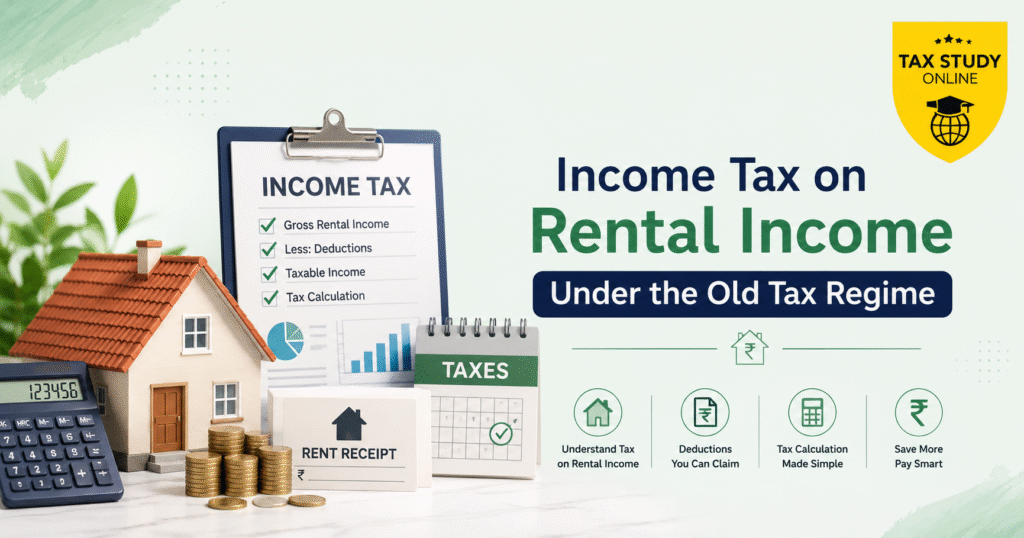
Mr. Sharma is a salaried employee working in a private company in Delhi. He purchased a residential flat by taking a home loan and rented out the property.
During the financial Year 2025-26, he received Rs. 5 Lakh as rental income from the property and paid Rs. 1.5 Lakh as interest on the home loan taken for the same property.
When it was time to file his Income Tax Return (ITR), he had a lot of questions.
- Do I have to pay tax on the entire Rs. 5 lakh?
- Can I claim deduction for municipal taxes paid?
- Can I claim deduction for home loan interest under the old tax regime?
- If my home loan interest exceeds my rental income, can I adjust the loss against my salary?
- Can I carry forward the loss from house property to future years?
If you also earn rental income, you may have similar questions.
The good news is that the Tax is not calculated on the total rent received. The Income Tax Act allows certain deductions while computing income from house property.
What You’ll Learn in This Article
In this practical example, you’ll learn:
- How to calculate taxable rental income under the old tax regime.
- How municipal taxes reduce taxable rental income.
- How the 30% standard deduction under Section 24(a) works.
- How to claim deduction for home loan interest.
- How loss from house property can be set off against other income.
- When loss from house property can be carried forward to future years.
- Common mistakes landlords make while filing their Income Tax Return.
Let’s understand Mr. Sharma’s case step by step.
Mr. Sharma’s Situation
| Particulars | Amount |
| Annual Rent Received | Rs. 5,00,000 |
| Municipal Taxes Paid | Rs. 20,000 |
| Home Loan Interest Paid | Rs. 1,50,000 |
Now let’s calculate his taxable income from house property under old tax regime.
Step 1: Calculate Gross Annual Value (GAV)
Since Mr. Sharma rented out the property throughout the year and received rent of Rs. 5 Lakh.
Gross Annual Value (GAV) = Rs. 5,00,000
Step 2: Deduct Municipal Taxes
Municipal taxes actually paid by the owner during the financial year are allowed as a deduction.
| Particulars | Amount |
| Gross Annual Value | Rs. 5,00,000 |
| Less: Municipal Taxes Paid | Rs. 20,000 |
| Net Annual Value (NAV) | Rs. 4,80,000 |
Step 3: Claim Standard Deduction
Under Section 24(a), a deduction equal to 30% of the Net Annual Value is allowed towards repairs and maintenance.
Calculation
30% × Rs. 4,80,000 = Rs. 1,44,000
This deduction is available even if no repair expenses were actually incurred.
Step 4: Claim Home Loan Interest Deduction
Under the old tax regime, interest paid on a housing loan for a let-out property is fully deductible under Section 24(b) without any ceiling limit.
Mr. Sharma paid:
Home Loan Interest = Rs. 1,50,000
Therefore,
Deduction under Section 24(b) = Rs. 1,50,000
Step 5: Calculate Taxable Income from House Property
| Particulars | Amount |
| Gross Annual Value | Rs. 5,00,000 |
| Less: Municipal Taxes | Rs. 20,000 |
| Net Annual Value | Rs. 4,80,000 |
| Less: Standard Deduction (30%) | Rs. 1,44,000 |
| Less: Home Loan Interest | Rs. 1,50,000 |
| Taxable Income from House Property | Rs. 1,86,000 |
Therefore, although Mr. Sharma earned Rs. 5 Lakh as rent, only Rs. 1.86 Lakh is taxable under the head Income from House Property.
Compare your tax liability by reading our New Tax Regime guide for rental income.
Set-off and Carry Forward of House Property Loss Under the Old Tax Regime
Suppose Mr. Sharma had paid Rs. 6,00,000 as home loan interest instead of Rs. 1,50,000.
His calculation would be:
| Particulars | Amount |
| Net Annual Value | Rs. 4,80,000 |
| Less: Standard Deduction 30% | Rs. 1,44,000 |
| Balance | Rs. 3,36,000 |
| Less: Home Loan Interest | Rs. 6,00,000 |
| Loss from House Property | Rs. 2,64,000 |
Under the old tax regime, Mr. Sharma can:
- Set off against salary or other heads of income up to Rs. 2 lakh in the same financial year 2025-26.
- carry forward the remaining loss of Rs. 64,000 for up to 8 assessment years.
- Set off the carried-forward loss of Rs. 64,000 against income from house property in future years.
Mr. Sharma can avail of the benefit of carrying forward the remaining loss only if he files his Income Tax Return on or before the due date. i.e. 31.07.2027 or 31.08.2027 ( As applicable)
The deduction under Section 80C is available only if the taxpayer opts for the old tax regime.
Section 80C Benefit Available Under the Old Tax Regime
Apart from claiming the deduction for home loan interest while calculating income from house property, Mr. Sharma may also claim the following deductions under Section 80C, if he fulfils the required conditions:
- Principal repayment of the home loan
- Stamp duty
- Registration charges
The total deduction available under Section 80C is subject to the overall limit prescribed under the Income Tax Act. This deduction is not available in the new tax regime.
Why Is the Entire Rs. 5 Lakh Not Taxable?
Many taxpayers believe that tax is payable on the entire rent received.
That is incorrect.
Under the old tax regime, the following deductions are available:
- Municipal taxes actually paid by the owner
- Standard deduction of 30% under Section 24(a)
- Home loan interest under Section 24(b) for a let-out property
Only the remaining amount is taxable.
Common Mistakes Landlords Make
- Paying tax on the entire rental income without claiming deductions.
- Forgetting to deduct municipal taxes actually paid.
- Not claiming the 30% standard deduction.
- Missing the deduction for home loan interest.
- Not adjusting house property loss against other income in the same financial year.
- Failing to carry forward the remaining loss after filing the return on time.
- Failing to file the income tax return on or before the due date.
- Reporting rental income under the wrong head while filing the ITR.
- Not maintaining proof of municipal tax payments.
TaxStudyOnline’s Final Takeaway
Before calculating tax on rental income under the old tax regime, remember these important points:
- Tax is not calculated on the total rent received.
- Deduct municipal taxes actually paid by the owner.
- Claim the 30% standard deduction under Section 24(a).
- Claim the full deduction for interest paid on a home loan for a let-out property under Section 24(b).
- Claim deduction under Section 80C for home loan principal repayment, if eligible.
- Loss from house property can be adjusted against other income ( Example salary) up to Rs. 2 lakh in the same financial year and the remaining loss, if any, can be carried forward for the next 8 years, provided the return of the current year is filed within the due date.
- In subsequent years, the loss from house property can be set-off against income from house property income only.
- Maintain proper records of rent received, municipal tax payments, and home loan interest certificates.
- Report rental income under the head Income from House Property while filing your Income Tax Return.
Conclusion
Mr. Sharma’s case clearly explains how rental income is taxed under the old tax regime.
Although he earned Rs. 5 Lakh as rental income during the financial year, tax is not payable on the entire amount. After claiming deductions for municipal taxes, the standard deduction under Section 24(a), and home loan interest under Section 24(b), his taxable income from house property comes down to Rs. 1,86,000.
The old tax regime also offers additional advantages, such as deduction for home loan principal repayment under Section 80C, the ability to set off house property loss against other income up to Rs. 2 lakh in the same financial year, and carry forward the remaining loss for eight assessment years and set off in set-off in subsequent years, against income from house property income only.
Understanding these provisions can help landlords reduce their tax liability, file their Income Tax Return correctly, and make informed decisions while choosing between the old and new tax regimes.
FAQs
1. Is rental income fully taxable under the old tax regime?
No. Rental income is taxable after deducting municipal taxes paid, the 30% standard deduction under Section 24(a), and eligible home loan interest under Section 24(b).
2. Can I claim the 30% standard deduction even if I did not spend anything on repairs?
Yes. The deduction under Section 24(a) is allowed irrespective of the actual repair or maintenance expenses incurred.
3. Can I claim home loan interest deduction for a self-occupied house under the old tax regime?
Yes. The entire interest paid on a housing loan for a let-out property is deductible while computing income from house property.
4. Can I claim home loan interest for a self-occupied house?
Yes. Under the old tax regime, interest paid on a housing loan for a self-occupied property is deductible up to Rs. 2 lakh per financial year, subject to the conditions specified under the Income Tax Act.
5. Can I set off house property loss against salary income?
Yes. Under the old tax regime, loss from house property can be adjusted against salary or other income up to Rs. 2 lakh in the same financial year.
6. Can I carry forward unadjusted house property loss?
Yes. Any unadjusted loss can be carried forward for 8 assessment years, provided the Income Tax Return is filed within the due date.
7. Do municipal taxes reduce taxable rental income?
Yes. Municipal taxes actually paid by the owner during the financial year are deducted from the Gross Annual Value before calculating the standard deduction.
8. Can I claim deduction for home loan principal repayment?
Yes. Under the old tax regime, repayment of the principal amount of a housing loan is eligible for deduction under Section 80C, subject to the overall limit and prescribed conditions.
9. Which ITR form should I file if I have rental income?
The applicable ITR form depends on your total income and sources of income. Taxpayers having income from house property generally file ITR-1 (if eligible) or ITR-2, depending on their individual circumstances.