
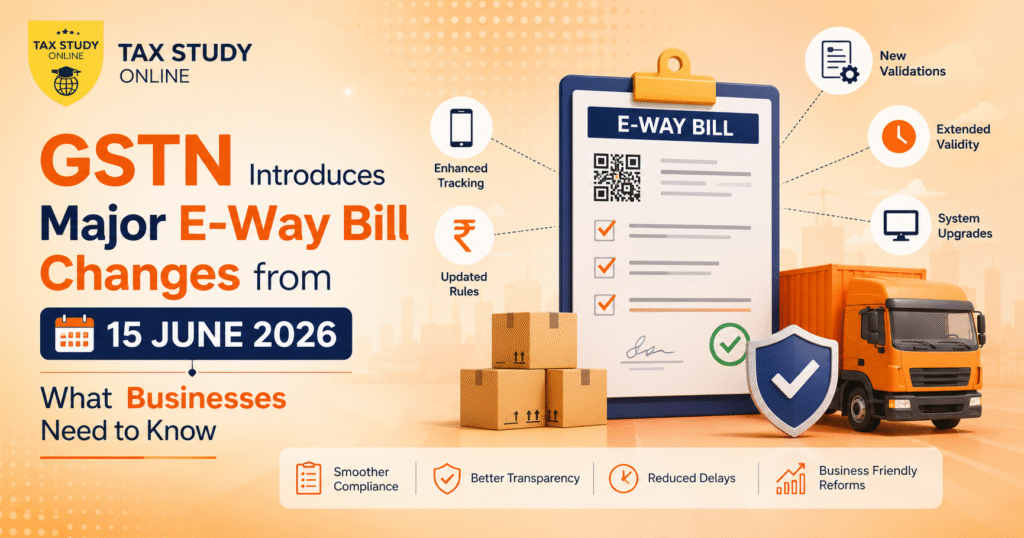
The Goods and Services Tax Network (GSTN) has announced significant updates to the E-Way Bill system that will impact businesses involved in the movement of goods across India. As per the GSTN advisory issued on 20 May 2026, two important enhancements are scheduled to be implemented on the E-Way Bill portal by 15 June 2026.
The first change requires businesses to report the Ship-To GSTIN in Bill-To/Ship-To transactions, while the second introduces a Voluntary E-Way Bill Closure Facility that enables users to formally close an E-Way Bill after they complete the delivery of goods.
These changes aim to strengthen transparency, improve traceability of goods movement, and enhance GST compliance. Businesses should begin preparing immediately to ensure a smooth transition.
Understanding the Importance of E-Way Bills
An E-Way Bill is much more than a transportation document. It plays a critical role in the GST compliance framework and serves as a key link between invoices, GST returns, e-invoices, and transportation records.
Under Rule 138 of the CGST Rules, 2017, every registered person must generate an E-Way Bill before moving goods with a consignment value exceeding ₹50,000, subject to the prescribed conditions and exceptions.
Today, E-Way Bill data is closely integrated with:
- Tax invoices
- GSTR-1 filings
- GSTR-3B returns
- E-invoice records
- Input Tax Credit (ITC) reconciliation
- Transportation and logistics documentation
Any mismatch between these records can lead to departmental inquiries, penalties, detention of goods, or scrutiny during GST audits.
Therefore, these updates are not only relevant for tax and accounts teams but also for logistics, dispatch, warehouse, ERP, and compliance departments.
Major Change 1: Mandatory Ship-To GSTIN in Bill-To/Ship-To Transactions
One of the most significant changes announced by GSTN is the mandatory reporting of the Ship-To GSTIN in Bill-To/Ship-To transactions.
What Are Bill-To/Ship-To Transactions?
In many business scenarios, the entity receiving the invoice is different from the actual delivery location. For example:
- Goods may be billed to a corporate head office but delivered to a branch office.
- Supplies may be invoiced to a principal company but shipped directly to a dealer or distributor.
- Deliveries may be made to warehouses, project sites, job workers, or third-party consignees.
Under the new system, businesses will be required to enter the Ship-To GSTIN while generating the E-Way Bill.
Where the consignee is not registered under GST, the value “URP” (Unregistered Person) must be entered in the Ship-To GSTIN field.
Why Is This Change Important?
The mandatory Ship-To GSTIN requirement is expected to:
- Improve destination-level tracking of goods movement.
- Enhance transparency in supply chain transactions.
- Reduce ambiguity in Bill-To/Ship-To arrangements.
- Strengthen GST data reconciliation.
- Support more accurate verification and compliance monitoring.
Action Points for Businesses
Organizations should immediately review and update:
- Customer master records
- Branch GSTIN details
- Warehouse GST registrations
- Delivery location databases
- ERP and accounting software configurations
Ensuring data accuracy before implementation will help avoid disruptions in E-Way Bill generation.
Major Change 2: Introduction of Voluntary E-Way Bill Closure Facility
GSTN has also introduced a new Voluntary E-Way Bill Closure Facility, allowing users to formally close an E-Way Bill after successful delivery of goods.
This closure can be performed by:
- The supplier
- The recipient
- The transporter
- The driver or authorized person whose mobile number has been registered for closure purposes
Why This Facility Matters
Many businesses currently generate E-Way Bills but do not maintain a structured mechanism to confirm and record the completion of goods movement.
The new closure feature helps create a complete transaction trail from dispatch to delivery.
Key benefits include:
- Better monitoring of goods movement
- Improved internal controls
- Reduced confusion regarding open or pending E-Way Bills
- Enhanced audit readiness
- Stronger documentation for compliance purposes
For businesses handling large volumes of daily dispatches, this feature can significantly improve operational efficiency.
How the E-Way Bill Closure Process Will Work
According to the GSTN advisory, users will have the option to close E-Way Bills either:
- Individually (E-Way Bill-wise), or
- In bulk based on a specific date
The closure functionality will be available within the E-Way Bill section of the portal after user login.
Mobile Number-Based Closure Authorization
GSTN has also introduced the option to provide a dedicated mobile number for E-Way Bill closure.
Currently, this feature is voluntary.
The authorized mobile number can be entered:
- During E-Way Bill generation
- While updating vehicle details
- During consolidated E-Way Bill operations
- While extending E-Way Bill validity
This allows designated personnel to manage closure activities efficiently and securely.
Closure Timeline: Same Day or Next Day
GSTN has clarified that E-Way Bills can be closed:
- On the same day as delivery, or
- On the immediately succeeding day
This requirement makes timely delivery confirmation essential.
Businesses should establish clear coordination among:
- Dispatch teams
- Transporters
- Drivers
- Warehouse personnel
- Accounts and compliance departments
A well-defined Standard Operating Procedure (SOP) enables teams to complete closure activities within the prescribed timeline.
ERP and API Users Should Prepare in Advance
GSTN has already released the necessary API updates in the NIC sandbox environment.
ERP vendors, GST Suvidha Providers (GSPs), Application Service Providers (ASPs), and system integrators must begin testing and implement the required modifications before the production rollout.
Data Fields ERP Systems Must Support
Businesses generating E-Way Bills through ERP systems or accounting software should ensure their systems can capture:
- Ship-To GSTIN
- E-Way Bill Number
- Closure Date
- Closure Remarks
- Authorized Mobile Number (where applicable)
Organizations using customized software solutions should coordinate with their technology partners immediately to avoid last-minute compliance challenges.
Understanding the Difference Between Cancellation and Closure
A common area of confusion may arise between E-Way Bill cancellation and E-Way Bill closure.
E-Way Bill Cancellation
Cancellation applies when:
- Goods are not transported, or
- The transportation does not occur as per the details originally furnished in the E-Way Bill
Rule 138(9) of the CGST Rules provides for cancellation within the prescribed time limit, subject to specific conditions.
E-Way Bill Closure
Closure applies when:
- Goods have been successfully delivered, and
- The movement transaction has been completed
In simple terms, businesses cancel an E-Way Bill when transportation does not proceed as planned, while they close it after successfully completing the delivery.
Practical Impact on Businesses
The upcoming E-Way Bill changes will have a direct impact on day-to-day GST compliance and logistics operations.
Businesses should review the following areas before 15 June 2026:
Compliance Review Checklist
- Bill-To and Ship-To mapping processes
- Customer and delivery location master data
- Branch and warehouse GSTIN records
- ERP and accounting software configurations
- Transporter and driver coordination mechanisms
- Mobile number-based closure procedures
- Delivery confirmation workflows
- E-Way Bill closure responsibilities
- Reconciliation between invoices, E-Way Bills, GST returns, and delivery records
- Training programs for accounts, dispatch, logistics, and compliance teams
Final Thoughts
The latest GSTN updates represent an important step toward improving transparency, accountability, and traceability in the movement of goods under the GST regime.
While the mandatory Ship-To GSTIN requirement will strengthen destination-level tracking, the voluntary E-Way Bill Closure Facility will help businesses maintain a complete and auditable record of goods movement from dispatch to delivery.
With the implementation date approaching on 15 June 2026, businesses should proactively review their processes, update master data, modify ERP systems, and train relevant teams to ensure seamless compliance.
Organizations that prepare early will not only avoid operational disruptions but also strengthen their overall GST compliance framework and internal controls.