India’s tax compliance environment may soon become significantly more practical and proportionate. The Central Board of Direct Taxes (CBDT), through the draft Income-tax Rules, 2026, has proposed revising several PAN reporting thresholds that have long been considered outdated.
If approved, these revised rules will take effect from April 2026, reducing compliance burdens for individuals, small businesses, and transaction-based industries such as real estate, automobiles, hospitality, and banking.
This article examines the changes in detail, their background, sector-wise impact, and the broader policy direction behind the move.
Why PAN Reporting Thresholds Matter
Permanent Account Number (PAN) serves as the backbone of financial tracking in India. It helps tax authorities:
- Track high-value transactions
- Cross-verify income declarations
- Monitor potential tax evasion
- Maintain transparency in financial reporting
However, many existing PAN thresholds were fixed years ago when transaction values were significantly lower. With inflation, rising property prices, and increasing service costs, even routine transactions began crossing reporting limits.
This led to:
- Over-reporting of relatively small transactions
- Increased paperwork for businesses
- Compliance fatigue among taxpayers
- Administrative overload for reporting entities
The proposed 2026 reforms aim to recalibrate thresholds in line with economic realities.
Key Proposed Changes in Detail
1. Hotel, Restaurant & Event Payments
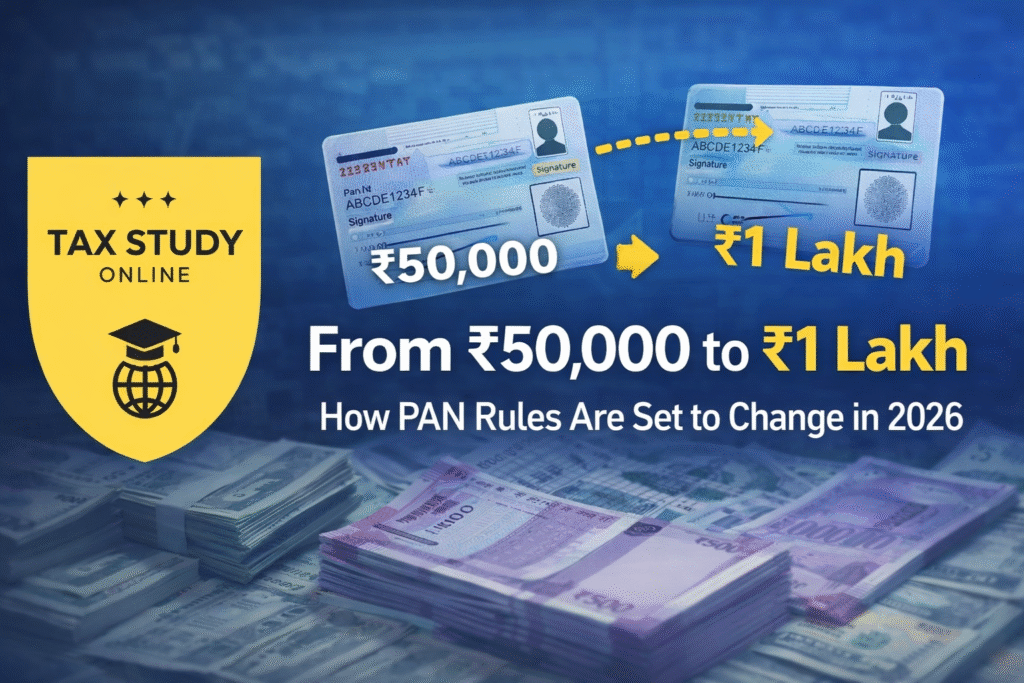
Threshold Increase: ₹50,000 → ₹1 Lakh
Earlier Rule: PAN was required when payments to hotels, restaurants, or event venues exceeded ₹50,000.
Proposed Rule (from April 2026): PAN will be required only if the payment exceeds ₹1 lakh.
Why This Change Is Significant
In today’s economic environment:
- Wedding bookings frequently exceed ₹50,000.
- Corporate events routinely cross that limit.
- Banquet hall reservations often require large advance payments.
The earlier ₹50,000 threshold effectively made PAN disclosure common for mid-range events, even where no tax risk existed.
Practical Impact
- Reduced compliance for individuals organizing family functions.
- Simplified billing for hotels and banquet halls.
- Fewer reporting obligations for hospitality businesses.
- Less data clutter for tax authorities.
The doubling of the threshold recognizes that ₹50,000 no longer represents a high-value transaction.
2. Bank Cash Deposits & Withdrawals
Structural Shift: Daily Trigger → Annual Aggregate
Earlier Rule: PAN required if a cash deposit or withdrawal exceeded ₹50,000 in a single day.
Proposed Rule: PAN required only if the total yearly cash deposits/withdrawals exceed ₹10 lakh.
Why This Is a Major Reform
The earlier per-day trigger created compliance challenges:
- Small traders depositing cash sales periodically crossed ₹50,000.
- Individuals making one-time large withdrawals triggered reporting.
- Banks had to monitor each transaction individually.
The proposed change shifts focus to annual financial behavior rather than isolated events.
Implications
- Occasional high-value deposits will not automatically trigger reporting.
- Monitoring becomes more aligned with actual financial capacity.
- Administrative burden on banks may reduce.
- Cash-intensive small businesses gain operational ease.
This reform reflects a smarter compliance model—monitoring sustained financial patterns instead of isolated transactions.
3. Property Transactions
Threshold Increase: ₹10 Lakh → ₹20 Lakh
Earlier Rule: PAN required for property transactions exceeding ₹10 lakh.
Proposed Rule: PAN required only if transaction value exceeds ₹20 lakh.
Economic Context
Property prices have risen significantly over the years. In many cities, even modest residential units exceed ₹20 lakh. The earlier ₹10 lakh limit was no longer reflective of real market conditions.
Impact on Stakeholders
- Buyers and sellers of lower-value properties face fewer formalities.
- Documentation load in semi-urban and tier-2 markets reduces.
- Property registration processes become smoother.
- Real estate transactions in smaller towns become easier.
While PAN remains mandatory for higher-value transactions, the new threshold prevents over-regulation of modest property deals.
4. Vehicle Purchases
Threshold-Based Requirement: Above ₹5 Lakh
Earlier Rule: PAN was mandatory for most car purchases, regardless of value.
Proposed Rule: PAN required only if the vehicle’s value exceeds ₹5 lakh.
Why This Matters
With increasing automobile prices, entry-level cars frequently approach the ₹5 lakh range. The earlier blanket requirement led to universal PAN submission even for basic purchases.
Expected Benefits
- Relief for small vehicle buyers.
- Faster processing at dealerships.
- Simplified documentation for automobile dealers.
- Reduced compliance for rural and semi-urban customers.
Broader Policy Objectives Behind the Reform
The proposed changes reflect three key policy themes:
- Proportional Compliance: Monitoring should focus on genuinely high-value or suspicious transactions – not routine spending.
- Ease of Doing Business: Lower documentation requirements help industries function more efficiently.
- Inflation-Adjusted Governance: Financial thresholds must evolve with economic growth and rising transaction values.
By increasing limits, the government aims to reduce friction without weakening transparency.
Sector-Wise Impact Analysis
Individuals & Households
- Fewer instances of mandatory PAN submission.
- Less documentation during weddings or large gatherings.
- Easier banking experience for occasional cash transactions.
Small & Medium Businesses
- Reduced compliance triggers.
- Lower risk of procedural lapses.
- Administrative time savings.
Banks
- Shift from daily transaction tracking to aggregate monitoring.
- Reduced reporting noise.
- Improved focus on meaningful financial patterns.
Real Estate & Automobile Industry
- Faster transaction closures.
- Reduced paperwork.
- Smoother customer onboarding.
What Does Not Change?
Despite the relaxation:
- PAN remains mandatory for high-value transactions.
- Authorities retain the power to request PAN for scrutiny.
- Anti-money laundering laws continue to apply.
- Reporting obligations remain intact where thresholds are crossed.
This is recalibration – not deregulation.
When Will These Changes Apply?
If approved, the revised thresholds will come into effect from April 2026 under the Income-tax Rules, 2026.
Until then, existing PAN rules continue to apply. Taxpayers and businesses must not assume relaxation before official implementation.
Compliance Advice for Taxpayers
- Continue following current PAN requirements until notified.
- Track annual cash deposits if approaching ₹10 lakh.
- Stay updated with CBDT notifications.
- Maintain proper documentation even if PAN is not required.
- Consult tax professionals for high-value transactions.
Conclusion:
The proposed shift from ₹50,000 to ₹1 lakh in hospitality payments – and similar increases across banking, property, and vehicle transactions – signals a more pragmatic approach to tax governance.
By aligning reporting thresholds with current economic realities, the draft Income-tax Rules, 2026 aim to:
- Reduce compliance fatigue
- Minimize unnecessary reporting
- Improve ease of transactions
- Maintain focus on genuinely high-value activities
If implemented, April 2026 could mark a significant move toward balanced, proportionate, and business-friendly PAN compliance in India – where oversight remains strong, but everyday transactions become simpler and smoother.