The Income Tax system in India is evolving steadily toward greater transparency, flexibility, and taxpayer convenience. One of the most important reforms in recent years relates to the time limits for filing a Revised Income Tax Return (ITR). Mistakes in tax returns are common, even among careful taxpayers, and the law recognises this by allowing revisions within a specified period.
With the introduction of extended time limits, taxpayers now have more breathing room to correct errors, align their returns with updated tax data, and avoid unnecessary penalties or disputes. This detailed guide explains every aspect of the revised return mechanism, including legal provisions, timelines, fees, practical examples, and best practices.
1. Understanding the Concept of Revised Income Tax Return
A Revised Income Tax Return is a corrective return filed when a taxpayer discovers an error or omission in the original or belated return already submitted.
Legally, it is governed by Section 139(5) of the Income-tax Act, 1961, which allows taxpayers to revise returns to ensure correctness and completeness.
Common Reasons for Filing a Revised Return
- Missed reporting of interest income (bank, FD, savings)
- Incorrect head of income selection
- Claiming incorrect deductions under Chapter VI-A
- Mismatch between Form 26AS / AIS and ITR
- Wrong carry forward of losses
- Errors in TDS details
- Clerical or calculation mistakes
A revised return is not treated as a separate return — it replaces the original return completely.
2. Legal Framework and Applicability
Section 139(5) – Key Highlights
- A revised return can be filed only if an original or belated return exists
- The revised return must be filed within the prescribed time limit
- Assessment should not have been completed
- Revision can be done multiple times within the allowed period
This provision supports voluntary compliance and reduces the need for departmental intervention.
3. Earlier Time Limit: A Brief Recap
Before the recent amendments, the time limit for filing a revised return was:
➡ Up to 9 months from the end of the assessment year
Practical Impact of the Old Rule
- Limited time for correction
- Belated return filers often had no revision window
- Errors discovered after December could not be corrected
- Increased use of updated returns with additional tax cost
4. New Time Limits for Revised Income Tax Return
The revised framework extends the permissible time for revision.
Current Time Limit
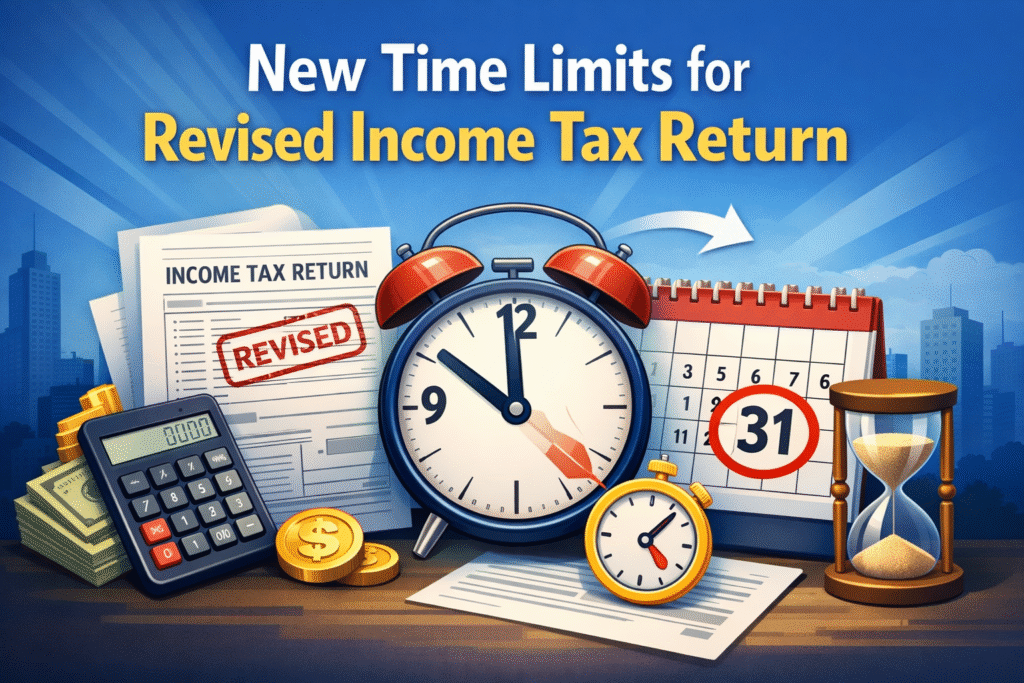
A revised return can now be filed up to 12 months from the end of the relevant assessment year, i.e., up to 31 March following the end of the assessment year.
Timeline Illustration
| Particulars | Old Limit | New Limit |
| Time available | 9 months | 12 months |
| Last date | 31 December | 31 March |
| Flexibility | Limited | Enhanced |
This extension aligns tax compliance with real-world timelines where information often becomes available late.
5. Fee and Cost Implications of Late Revision
The extended timeline introduces a balanced approach — flexibility with accountability.
Fee Structure Explained
- Revision within 9 months
→ No additional fee - Revision between 9 and 12 months
→ Late revision fee applicable
This ensures that taxpayers who act promptly are not penalized, while those using the extended period contribute a nominal fee.
6. Practical Scenarios Where the Extended Time Helps
1: Salaried Employee
A salaried employee receives a corrected Form 16 in February due to late bonus adjustments. Under the old rule, revision was impossible. Under the new limit, the return can be revised till March.
2: Freelancer or Consultant
A freelancer receives Form 26AS updates reflecting delayed client TDS entries. The extended window allows proper reconciliation.
3: Foreign Income Disclosure
Taxpayers with foreign income or assets often receive information late due to cross-border delays. The extra time helps avoid misreporting.
7. Impact on Belated Return Filers
One of the most significant advantages of the new rule is for taxpayers who file belated returns.
Earlier: Belated returns filed close to December had little or no scope for revision.
Now: Even belated returns filed late can be revised until March.
This promotes fairness and reduces hardship.
8. How Many Times Can a Revised Return Be Filed?
There is no restriction on the number of revisions.
Important points:
- Each revision must be within the permitted time
- The latest revised return overrides all previous returns
- Frequent revisions should be avoided unless necessary
9. Step-by-Step Process to File a Revised Return
- Log in to the Income Tax e-Filing Portal
- Select the relevant Assessment Year
- Choose “Revised Return under Section 139(5)”
- Enter original return acknowledgement number and date
- Make corrections carefully
- Submit and e-verify
Without verification, the revised return is invalid.
10. Revised Return vs Updated Return
| Criteria | Revised Return | Updated Return |
| Legal section | 139(5) | 139(8A) |
| Purpose | Correction of errors | Declaration of missed income |
| Time limit | 12 months | 48 months |
| Additional tax | Generally none | Mandatory |
| Penalty exposure | Minimal | Higher |
| Best use | First correction option | Last resort |
Tip: Always prefer a revised return over an updated return when possible.
11. Common Mistakes to Avoid While Revising
- Revising without checking AIS and Form 26AS
- Incorrectly selecting the return type
- Not carrying forward losses correctly
- Forgetting to re-verify the return
- Assuming partial changes are allowed (entire return is replaced)
12. Best Practices for Taxpayers
- Maintain proper documentation
- Reconcile tax data before revision
- Revise early to avoid fees
- Consult a tax professional for complex cases
- Keep acknowledgement numbers safely
13. Role of Revised Returns in Reducing Tax Litigation
Accurate self-correction:
- Reduces mismatch notices
- Avoids scrutiny and reassessment
- Builds a compliance-friendly tax environment
- Saves time and professional costs
The extended timeline encourages voluntary corrections rather than enforced compliance.
14. Key Takeaways
- Revised return time limit extended to 12 months
- Extra flexibility with a structured fee mechanism
- Especially beneficial for belated filers and complex cases
- Encourages accuracy and transparency
- Aligns tax law with practical realities
Final Conclusion
The extension of time limits for filing a revised income tax return is a progressive and taxpayer-centric reform. It recognises that errors are often unintentional and that access to accurate financial data may be delayed. By offering additional time with reasonable safeguards, the law promotes responsible self-compliance while reducing disputes and penalties.
Taxpayers should treat the revised return facility as a corrective tool — not a casual option — and use it wisely to ensure their tax filings are accurate, complete, and stress-free.